


Boost website visibility: Master 7 Proven Steps
Why Every Website Needs the Spotlight: Understanding Search Visibility
Boost website visibility is the foundation of getting found online—and it's no longer optional. If potential customers can't find your site, your business simply doesn't exist in their world. Here's what you need to know:
Quick Answer: How to Boost Website Visibility
- Target the right keywords through research and understand what your audience searches for.
- Create high-quality content that demonstrates expertise and answers real questions.
- Optimize on-page elements like titles, meta descriptions, headers, and image alt text.
- Build quality backlinks from relevant, authoritative websites in your industry.
- Fix technical issues including site speed, mobile-friendliness, and security (SSL).
- Claim local listings and optimize your Google Business Profile for local searches.
- Monitor and improve using analytics tools to track rankings, traffic, and user behavior.
With 93% of online queries starting on a search engine, being invisible means you're missing out. The hard truth is that only about 1% of Google users visit the second page of search results. If you're not on page one, you're missing the vast majority of potential traffic, leads, and sales.
But search is evolving. AI-powered engines like ChatGPT and Gemini receive almost seven billion visits per month, and Gartner predicts a 25% drop in traditional search engine use by 2026. The good news? The strategies that work for both are accessible to any business owner.
I'm Matthias Hamm, founder of Youniverse.Ai. For over a decade, I've helped businesses boost website visibility on traditional search engines and emerging AI channels. My mission is to make search optimization simple, actionable, and effective.
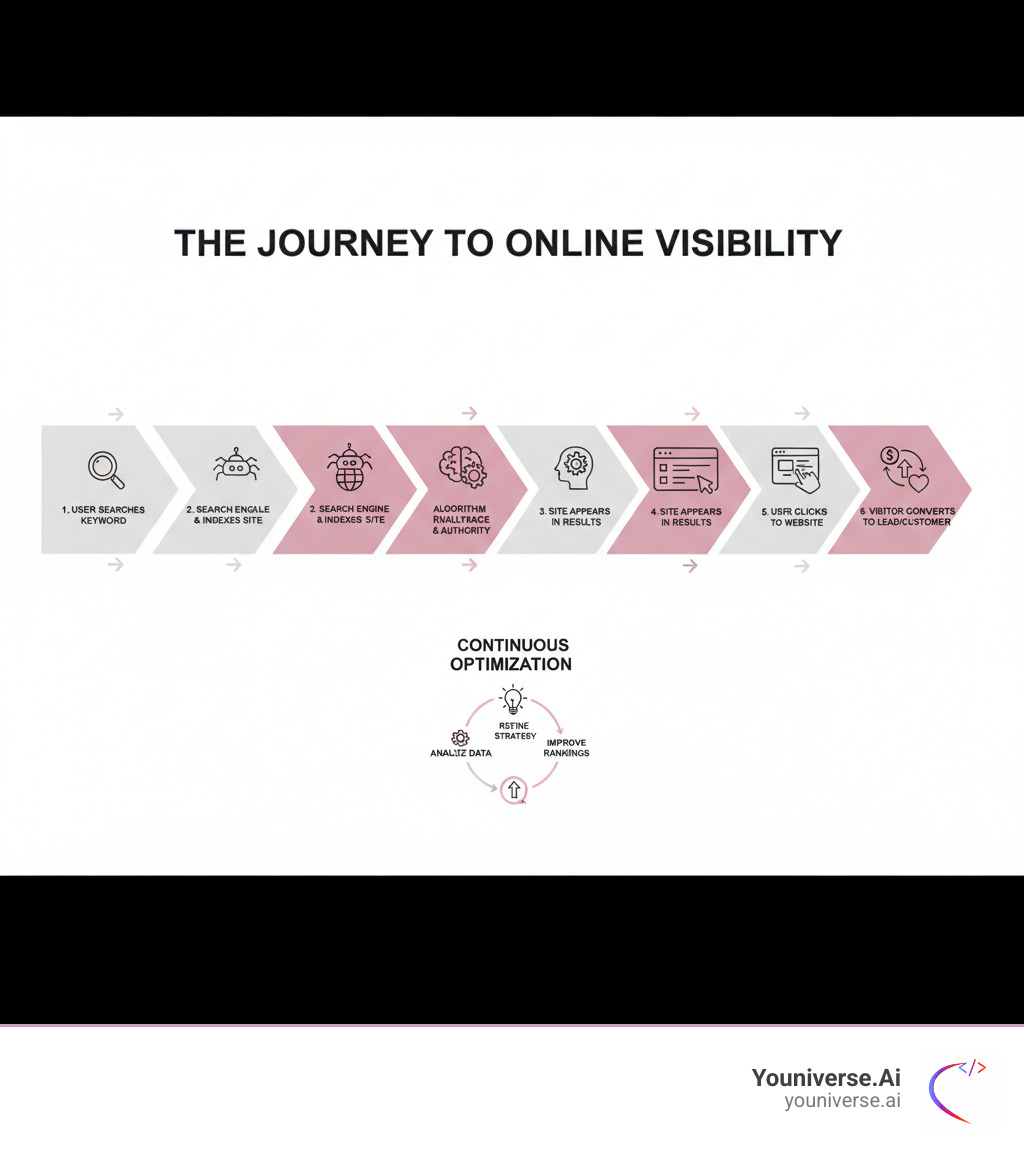
From Invisible to Invincible: Why Website Visibility is Your #1 Asset
Your website could be the most beautifully designed digital storefront on the planet, but if nobody can find it, does it even exist? That's why you need to boost website visibility—it's the single most important asset your business can develop online.
Google commands over 79% of the search market, meaning your customers start their journey there. But here's the kicker: only about 1% of users visit the second page of search results. If you're not on page one, you're invisible to 99% of searchers. Even on page one, the third result captures 18.6% of all clicks, so every position matters.
Search engines are smart. They evaluate signals like Dwell Time—how long visitors stay on your page. A long dwell time signals quality. This ties directly into E-E-A-T: Experience, Expertise, Authoritativeness, and Trustworthiness. Google wants to rank content from sources that truly know their stuff.
What is Search Engine Visibility & How Do Engines Rank Sites?
Search engine visibility is how easily people find you in the SERP (Search Engine Results Page). True visibility comes from dominating the organic results—the unpaid listings earned through quality and relevance. Your ranking position determines your share of traffic and builds brand awareness.
Search engines follow a three-step process:
- Crawling: Bots explore the web, following links to find new and updated content. If they can't access your site, you're invisible.
- Indexing: The finded content is stored in a massive database, like a library of the web. Google searches this index, not the entire internet, to find results quickly.
- Ranking: When you search, algorithms analyze hundreds of factors to deliver the best results. They focus on Relevance (matching your content to the query), Authority (how trustworthy your site is, often measured by backlinks), and User Satisfaction (click-through rates, mobile-friendliness, and site speed). Sites that aren't optimized for mobile may be downranked, making a good user experience non-negotiable.
Decoding the Matrix: The Four Pillars of Modern SEO

To truly boost website visibility, you need to master the four interconnected pillars of modern SEO. As we covered in How SEO Helps Your Site Get Found Online, each pillar supports the others to create a powerful strategy that search engines reward.
On-Page SEO: Optimizing What's on Your Site
This is everything on your website that you control directly. It’s about sending clear signals to search engines about your content.
- Content Quality: Create informative, engaging content that demonstrates E-E-A-T (Experience, Expertise, Authoritativeness, and Trustworthiness) and genuinely helps your audience.
- Keyword Usage: Naturally incorporate relevant keywords that match user intent. Avoid keyword stuffing.
- Title Tags & Meta Descriptions: Your title is the clickable headline in search results, while the meta description is your elevator pitch to convince users to click.
- Header Tags (H1, H2): Structure your content logically to improve readability for both users and search engine crawlers.
- Image Alt Text: Provide descriptive text for images to help search engines understand them and improve accessibility.
Off-Page SEO: Building Authority Across the Web
This pillar is about your website's reputation on the internet. It’s the digital equivalent of word-of-mouth marketing.
- Backlinks: These are links from other reputable websites, acting as "votes of confidence" that build your authority. Quality over quantity is key.
- Brand Mentions & Social Signals: Even unlinked mentions of your brand and an active social media presence contribute to your overall authority and drive traffic.
Technical SEO: The Foundation of a Healthy Website
This is the behind-the-scenes work that ensures search engines can crawl, index, and understand your site.
- Site Architecture & Speed: A logical site structure and fast loading times are critical for user experience and rankings.
- Mobile-Friendliness: With Google's mobile-first indexing, a responsive design that works on all devices is essential.
- Security (SSL) & Sitemaps: An SSL certificate (HTTPS) secures your site and is a ranking signal. An XML sitemap helps search engines find all your important pages.
Local SEO: Winning in Your Neighborhood
If you serve customers in specific geographic areas like York PA or Lancaster PA, local SEO is your secret weapon.
- Google Business Profile: This free listing is the cornerstone of local visibility. Keep it complete and accurate.
- Local Citations & Reviews: Consistent NAP (Name, Address, Phone) information across directories and positive customer reviews build trust and boost local rankings.
Your Action Plan: 7 Proven Steps to Boost Website visibility Today
Ready to get your website noticed? This action plan outlines proven steps to boost website visibility and attract more targeted traffic. It's your roadmap to getting found online!

First, a few key terms: Keyword (what people search for), SERP (the results page), Backlink (a link from another site), Alt Text (image description), Meta Description (the summary in search results), and Google Search Console (a free tool to monitor site health).
Step 1: Master Keyword Research
This is the crucial starting point. You must understand what your potential customers are searching for and the User Intent behind their queries. Start with broad Seed Keywords (e.g., "web design") and then find specific Long-Tail Keywords (e.g., "affordable web design York PA for small business"). These longer phrases have lower search volume but often convert better. Use tools like Google Keyword Planner and analyze your competitors to find opportunities.
Step 2: Create High-Quality, Authoritative Content
Content is king. Create articles, guides, and pages that offer real value by answering questions and solving problems. Your content should be unique, easy to read, and demonstrate your expertise. Don't just rehash what others have said; offer your fresh perspective. Regularly updating your content keeps it relevant and signals to search engines that your site is active.
Step 3: Perfect Your On-Page Elements
Present your great content perfectly. Your Compelling Titles (title tags) are your first impression in the SERP, so make them clear and include your main keyword. Craft a Persuasive Meta Description to convince users to click. Use a Strategic Heading Structure (H1, H2, H3) to organize your content for readers and search engines. Finally, optimize images with descriptive Alt Text to improve accessibility and SEO.
Step 4: Build a Strong Backlink Profile
Backlinks are "votes of confidence" from other websites that build your authority. The best way to get them is to create Link-Worthy Content—original research, comprehensive guides, or tools that others will want to reference. You can also pursue Guest Posting on reputable sites in your industry or use the Broken Link Building tactic. Quality is far more important than quantity. For more on how design influences this, check out What Good Web Design Looks Like Beyond Color.
Step 5: Dominate Local Search
For businesses serving local areas like York PA, Lancaster PA, or Towson MD, local SEO is a must. Claim and fully optimize your Google Business Profile with accurate hours, services, and photos. Encourage Reviews from happy customers and always respond to them. Finally, ensure NAP Consistency—your Name, Address, and Phone number must be identical across all online directories like Yelp and Facebook.
The Need for Speed: Mastering Technical SEO and Mobile-Friendliness
Imagine clicking a search result only to wait... and wait. You'd hit the back button, right? That's why technical SEO—especially site speed and mobile-friendliness—is critical to boost website visibility. These factors are fundamental to user experience (UX), and Google takes them seriously. In fact, sites that aren’t optimized for mobile may be downranked, undermining all your other efforts.
How to Boost Website Visibility with Site Speed
A fast website is essential. Even a one-second delay increases bounce rates. Here’s how to speed things up:
- Image Compression: Large, unoptimized images are a primary cause of slow load times. Compressing them reduces file size without sacrificing visual quality.
- Browser Caching: This allows a visitor's browser to store parts of your site locally, so return visits are almost instant.
- Minimize HTTP Requests: Every element on a page requires a request to the server. Reducing these requests by combining files speeds up your site.
At Youniverse.Ai, our platform is built for performance, supported by high-frequency WordPress hosting to ensure consistently fast load times.
Why Mobile-Friendliness is Non-Negotiable
With over half of all web traffic coming from mobile devices, Google uses mobile-first indexing. This means it primarily ranks the mobile version of your site. A responsive design that adapts to any screen size is the foundation. Your site must be easy to read and steer on a small touchscreen. You can use Google's Lighthouse testing tool to check your site's mobile performance and get recommendations.
The Importance of Security (SSL/HTTPS)
That little padlock icon in your browser's address bar signifies an SSL certificate (HTTPS). It's crucial for:
- User Trust: It shows visitors their connection is secure and encrypted.
- Data Protection: It protects any information exchanged, like contact form submissions.
- SEO Ranking Signal: Google gives a slight ranking boost to secure sites.
Modern browsers display prominent "Not Secure" warnings on sites without SSL, which can scare visitors away. At Youniverse.Ai, we include SSL certificates with our hosting, making security a standard, not an afterthought.
Beyond the Search Bar: Winning in the Age of AI and Chatbots
The rules of getting found online are changing. While Google is still king, AI platforms like ChatGPT, Gemini, and Perplexity now receive almost seven billion visits per month. Gartner even predicts a 25% drop in traditional search engine use by 2026. This means we must evolve our strategy to boost website visibility in these new channels.
These AI tools are answer engines. They synthesize information to provide direct answers, rather than just a list of links. To win, you need to be the source they choose to reference. This is why we developed our Answer Search Optimization approach—to get you found in both traditional and AI-powered search.
How to Boost Website Visibility in AI-Generated Answers
Getting featured in AI responses builds on solid SEO fundamentals with a few key adjustments:
- Structured Data (Schema Markup): This acts as a translator for AI models, explicitly labeling your content (e.g., as a product, FAQ, or local business). This clarity makes it easy for AI to extract and reference your information, which is vital for features like AI Overview features in Google.
- Clear, Concise Answers: Structure your content to answer questions directly and immediately. FAQ pages are perfect for this, as each question-answer pair is formatted for easy AI extraction.
- People-First Content: AI is learning to distinguish authentic expertise from generic fluff. Your unique insights, case studies, and real-world experience are more valuable than ever.
The Role of Social Media and Shareability
While social shares aren't a direct ranking factor like backlinks, they are a powerful amplifier for your brand visibility. An active social media presence expands your reach, drives traffic directly to your website, and fosters community engagement. When you promote your high-quality content on social platforms, it gains more exposure, which naturally leads to more backlinks as others find and share your work. It's a virtuous cycle that builds momentum over time.
Measure What Matters: Tracking Your SEO and Avoiding Common Pitfalls
SEO is like tending a garden; you can't just plant seeds and walk away. To boost website visibility, you must commit to monitoring, learning, and improving. Knowing what to measure and what mistakes to avoid makes the process manageable.
How to Monitor Your SEO Performance
Without tracking, you're flying blind. Focus on these key metrics:
- Keyword Rankings: Are you climbing in the search results for your target keywords?
- Organic Traffic Growth: How many people are finding your site through unpaid search? Google Analytics is perfect for tracking this.
- Click-Through Rate (CTR): How often do people click your listing in search results? A low CTR suggests your titles and meta descriptions need work.
- Backlink Profile: Monitor who is linking to you to ensure they are high-quality, relevant sites.
Your most powerful free tool is Google Search Console. It shows you which queries bring visitors, alerts you to errors, and offers a direct line of sight into how Google sees your site. Expect to see an increase in impressions within 4-6 months, which will gradually translate into more clicks.
Common SEO Mistakes to Avoid
Avoid these common traps that can undermine your hard work:
- Keyword Stuffing: Don't cram keywords unnaturally into your text. Write for people first.
- Low-Quality Links: Links from spammy or irrelevant sites can harm your rankings. Focus on earning quality links.
- Duplicate Content: Having the same content on multiple pages confuses search engines and dilutes your ranking power.
- Ignoring Technical Issues: A slow, broken, or non-mobile-friendly site will struggle to rank, no matter how good the content is.
- Lack of Patience: SEO is a marathon, not a sprint. Consistent effort over months yields sustainable, compounding results.
Frequently Asked Questions about Website Visibility
We hear these questions all the time from business owners. Here are the straight answers.
How long does it take to see results from SEO?
SEO is a long-term strategy, not a quick fix. Most businesses start seeing initial results within 4-6 months, beginning with an increase in search impressions. These gradually convert into more clicks and traffic. The effects of SEO are compounding; the longer you consistently apply best practices, the more your authority grows. Patience is essential for achieving sustainable, long-term returns.
Can I do SEO myself?
Yes, absolutely! Many business owners can handle the basics. You can learn to do keyword research, optimize content, and claim your Google Business Profile. Start by using free tools like Google Search Console and focus on creating helpful content for your customers. However, hiring an expert makes sense for competitive industries or complex technical issues. A professional can accelerate your results while you focus on running your business.
What's the most important rule of SEO?
If there's one golden rule, it's this: Create valuable, high-quality content that truly serves your target audience.
Everything else—backlinks, technical fixes, keywords—supports this goal. Search engines exist to provide the best answers. When you consistently deliver those answers, you align with their purpose and will be rewarded with better visibility. This means focusing on the user first and always practicing white-hat SEO (following guidelines) instead of black-hat SEO (using tricks). Sustainable success comes from providing genuine value.
Conclusion: Your Journey to the Top of Search
We've covered the essentials to boost website visibility, from the four pillars of SEO to a 7-step action plan. This isn't a one-time task but an ongoing journey. By consistently creating great content, building authority, and maintaining a technically sound website, you'll see growth that compounds over time.
The future of search is already here. AI-powered answer engines like ChatGPT and Gemini are changing how people find information. The businesses that win won't just rank in traditional search; they'll be the trusted sources AI models cite to answer user questions.
That's exactly why we built Youniverse.Ai. Our platform and AI Search Visibility Engine (AEO) are designed to help you thrive in this new landscape. We ensure your business is visible not just in Google, but also in the AI-generated answers where your future customers are looking.
The game is changing. Are you ready to get ahead of the curve?
Dive deeper into our approach with Answer Search Optimization and find how we can help you master the new era of search. Your customers are searching—let's make sure they find you first.