


AI Search Ranking Factors: Win 2025 SEO!
Why AI Search Ranking Factors Are Reshaping the Digital Landscape
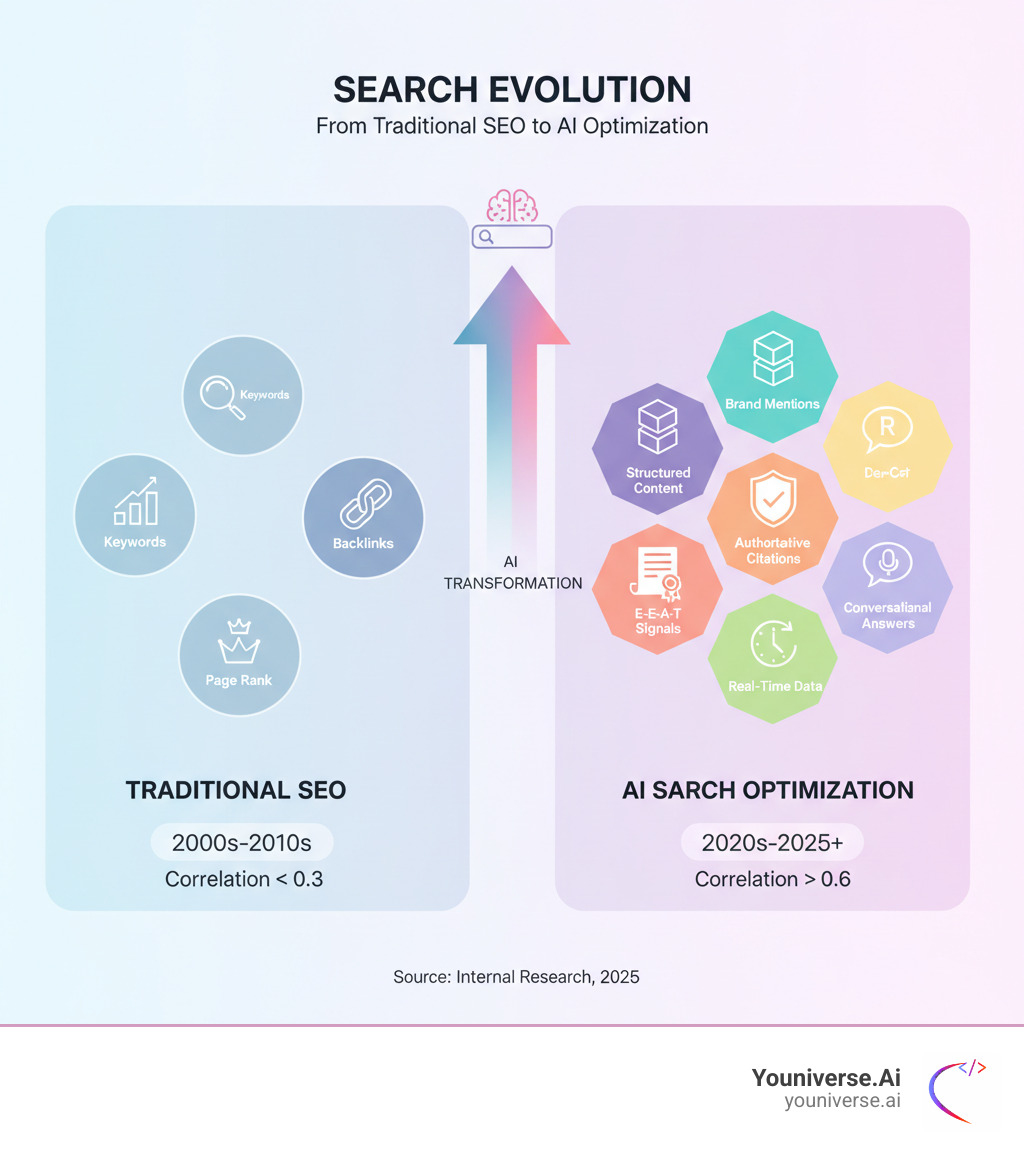
AI search ranking factors are a complete rewrite of the rules. Forget everything you thought you knew about SEO. In 2025, the signals that move the needle are fundamentally different, focusing on brand authority and trustworthiness.
Key factors now include:
- Brand Web Mentions: How often your brand is discussed online, linked or not.
- Authoritative Mentions: Being featured in "best of" lists and expert roundups.
- Brand Search Volume: How many people search for your brand by name.
- Content Structure & Data: How easily AI can understand and extract your content.
- Online Reviews & Freshness: Signals of real-world trust and relevance.
Traditional metrics like backlinks and Domain Rating still have a place, but they've been demoted from starring roles.
You've seen the change. AI Overviews are replacing the old "10 blue links," and chatbots like ChatGPT and Gemini are answering questions directly. Gartner predicts traditional search volume will drop 25% by 2026 as users turn to AI for answers.
Here's the problem: you can rank #1 on Google and still be invisible to AI. The opportunity? A staggering 26% of brands have zero mentions in AI Overviews, leaving the door wide open for businesses that adapt to what experts call Generative Engine Optimization (GEO).
AI doesn't just crawl your site; it reads the entire web's conversation about you. It looks for proof that real humans trust and recommend you. This guide breaks down what AI looks for and how you can become the answer it recommends.
I'm Matthias Hamm, founder of Youniverse.Ai. I've spent over a decade helping businesses steer major search shifts. Now, my focus is on AI search ranking factors. I've built one of the first platforms designed to optimize for AI visibility, helping clients rank in ChatGPT, Gemini, and Google's AI Overviews.
The New Authority: Why Brand Mentions Crush Traditional Backlinks
Here's a fact that would have sounded crazy five years ago: how often people talk about your brand now matters more than how many websites link to you.
The data is shocking. Brand web mentions show a 0.664 correlation with visibility in AI Overviews. Traditional backlinks? Just 0.218. That's a 3:1 difference in impact. Getting mentioned is now three times more valuable than getting a link.
The top AI search ranking factors are all about what other people say about you: brand web mentions (0.664), brand anchors (0.527), and brand search volume (0.392).
These correlation numbers, based on the Spearman's rank correlation coefficient, measure how strongly two things are related. A score near 1.0 indicates a strong relationship. So, 0.664 is a powerful signal.
Why the shift? AI reads the entire web—articles, forums, social media—to learn about your brand from how people discuss it. When your brand appears in trusted conversations, AI interprets that as genuine authority.
The New Off-Site SEO: Why Mentions are a Critical AI Search Ranking Factor
Today's off-site SEO is about building what Ryan Law calls "human authority." As he notes, unlinked mentions have a massive impact on Generative Engine Optimization (GEO) because AI models learn from the context and frequency of those mentions.
Digital PR is now essential. Getting featured on trusted platforms, contributing thought leadership, and joining industry conversations all feed AI's understanding of your brand. Whether you're based in York PA or Harrisburg PA, the goal is to become part of the digital conversation.
Platforms like Reddit, LinkedIn, and industry forums carry special weight because the conversations are genuine. Brands with the most web mentions receive up to 10 times more citations in AI Overviews. This isn't about gaming the system; it's about genuinely contributing value. The mentions will follow.
Branded Search and Its Surprising Impact on AI Visibility
When someone types your brand name into a search box, they're looking specifically for you. AI notices this. Brand search volume has a 0.392 correlation with AI visibility. Kevin Indig's research confirms it: "Brand search volume is the biggest predictor for visibility in ChatGPT."
Why? Branded searches signal trust and recognition. When thousands of people search for your brand, it tells AI you're established and worth recommending. For businesses in Lancaster PA or Towson MD, this means your local reputation directly translates into AI visibility.
Building brand recognition takes time, but it creates a powerful feedback loop: more searches lead to more AI visibility, which leads to more brand awareness. Brand building is now a core AI search ranking factor.
Decoding the Key AI Search Ranking Factors
Getting featured in a "best of" list can be more impactful than hundreds of backlinks. AI engines love authoritative roundups, citing them at impressive rates—impacting visibility by 41-64% across platforms like ChatGPT, Perplexity, and Google AI Overviews. When multiple reputable sources recommend your brand, AI sees it as an industry-wide endorsement.
But it's not just lists. AI search ranking factors span a wide range of trust signals:
- Awards and Accreditations: These badges of honor boost perceived authority, influencing recommendations by 15-19%.
- Online Reviews: Real customer feedback has a huge impact, especially on Perplexity (31%) and ChatGPT (16%).
- Customer Examples: Proof that real people use your products matters to AI, particularly for ChatGPT (14%) and Claude (13%).
Interestingly, traditional databases heavily influence Claude (68%), while Google Website Authority is a key factor for Google's AI Overviews (23%), as it builds on Google's core ranking systems. The takeaway is that AI synthesizes multiple signals to build a complete picture of your brand's authority.
On-Page Essentials: Content Structure as an AI Search Ranking Factor
AI doesn't read; it extracts. Your content must be structured for "extractability," with clear, chunkable answers.
- Lead with the answer: Start sections with direct, no-fluff answers to common questions.
- Use scannable headings: Descriptive H2 and H3 tags act as signposts for AI.
- Keep paragraphs short: Break complex ideas into bite-sized chunks.
- Use structured formats: Comparison tables, bullet points, and numbered lists are goldmines for AI because they present information in a format it can easily repurpose.
Optimizing for featured snippets is great practice for this. When we build sites for clients in York PA, we structure every piece of content to make AI's job easy. The easier you make it for AI to extract your content, the more likely it is to recommend you.
The Technical Edge: Structured Data and Schema Markup
Without structured data, your website is a wall of text to an AI. Schema markup from Schema.org adds invisible labels that tell AI what each piece of content is—a product, a review, a price, an FAQ.
A recent study on schema and AI Overviews found that pages with incomplete schema failed to appear in AI Overviews. You must be thorough. Use Product schema for e-commerce, FAQ schema for Q&A sections, and Article schema for blog posts.
The impact is dramatic: structured data can improve AI response quality by 300%. It's a cheat sheet for AI, removing ambiguity and making your content highly citable.
Content That AI Engines Love to Cite
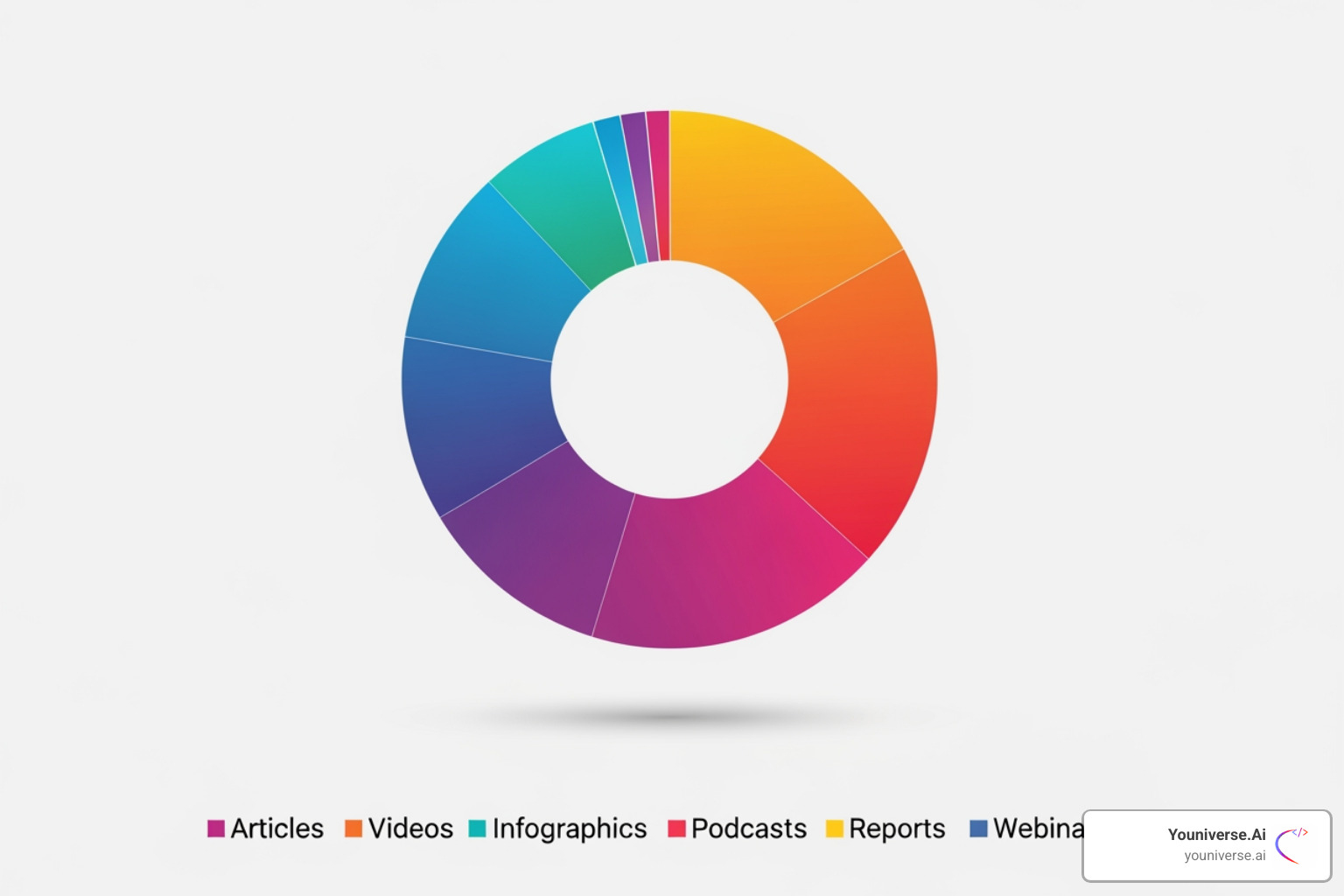
Certain content formats are naturally more citable for AI.
- Comparison Content: Articles and tables that compare products or services are incredibly easy for AI to parse.
- "Best Of" Reviews: Authoritative listicles are a trusted format that AI cites constantly.
- Tools and Calculators: Interactive tools offer unique value that AI can't replicate, making them a valuable resource to cite.
- Original Research & Opinion: Unique data and expert perspectives from recognized authorities are gold. AI relies on existing expert knowledge to form its answers.
Content freshness is also critical. AI models favor recent content, so regularly update your articles with new data and insights to signal ongoing relevance. As research from Seer Interactive confirms, creating content AI wants to cite is the winning formula.
Your Action Plan: How to Adapt Your SEO Strategy for the AI Revolution
The shift to AI-driven search requires you to actively reshape how you build authority online. Here's your action plan.
Start with E-E-A-T—Experience, Expertise, Authoritativeness, and Trustworthiness. This is Google's framework for quality, and AI models use it too. Showcase author credentials, share real-world examples, and demonstrate first-hand experience. For our clients in Lancaster PA or York PA, we highlight their unique local expertise, an authentic signal AI values.
Next, focus on semantic keyword integration. Instead of stuffing keywords, write naturally about your topic, including related concepts. This gives AI the rich context it needs to understand your offerings. Also, update your old content. Refreshing posts with current data and new perspectives signals relevance and keeps them in AI's rotation.
Understand query fan-out. When a user asks a complex question, the AI breaks it into multiple sub-questions to find the best answer. Your goal is to anticipate and answer these sub-queries.
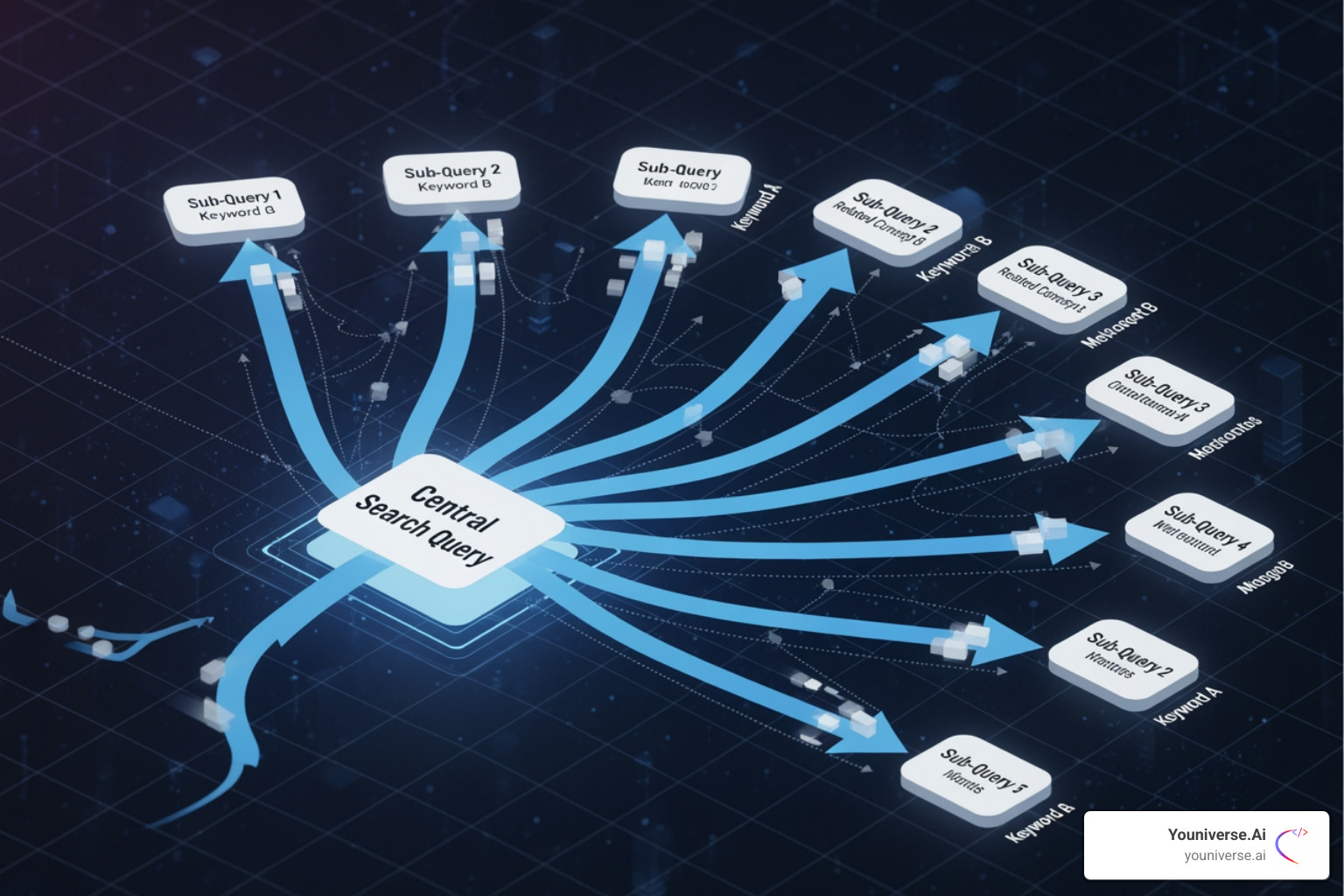
Don't just target "website builder." Create content that answers related questions like "how to choose a website builder for beginners" or "website builder with built-in SEO tools." By covering all the angles, you position your content as the comprehensive resource AI is looking for. For more, review Google's E-E-A-T guidelines.
Tracking Your Brand's Footprint in AI Search
Measuring success in AI search requires a multi-pronged approach, as no single dashboard shows everything.
- Manual Prompt Checks: Regularly ask ChatGPT, Gemini, and Perplexity questions your customers would ask. See if and how your brand appears.
- Google Search Console: Use GSC to monitor impressions and clicks from AI Overviews.
- SEO Analysis Tools: Many tools are adding features to track AI results. At Youniverse.Ai, our AI Search Visibility Engine is built for this.
- GA4 Custom Channels: Set up channel groups to track referral traffic from AI platforms like chat.openai.com.
- Share of Voice: Track how often your brand appears in relevant AI answers compared to competitors. This is your ultimate visibility metric.

This layered approach provides a clear picture of your AI visibility, helping you stay ahead of the curve.
The Weak Link: Do Paid Ads Influence AI Rankings?
Can you pay your way into AI search results? The short answer is not really.
Our research shows that paid factors like branded ad traffic (0.216 correlation) and ad cost (0.215 correlation) have a very weak connection to appearances in AI-generated answers. AI models are hunting for genuine, organic authority, not paid signals.
While Google is expanding ads in AI Overviews, these ads appear next to the AI content, not within it. The AI still chooses its sources based on organic AI search ranking factors.
Paid ads can still build brand awareness, which may indirectly boost branded searches. But if your goal is to be cited by the AI itself, your budget is better spent on building genuine authority through great content and securing mentions on trusted platforms. For now, organic brand building beats paid placement.
Frequently Asked Questions about AI Search Ranking
The shift to AI-powered search is massive. Here are answers to the most common questions we get.
Do traditional SEO metrics like backlinks still matter for AI search?
Yes, but their role has changed. Think of backlinks and Domain Rating as the foundation of your house—they're necessary for stability but aren't the main feature. Our research shows a weak correlation (0.218 for backlinks) compared to brand web mentions (0.664). They are table stakes, not the winning hand. AI uses them to establish baseline credibility before looking for stronger authority signals.
What is the single most important factor for AI Overview visibility?
If you focus on one metric, make it brand web mentions. With a correlation of 0.664, how often your brand is discussed across the web shows the strongest relationship with visibility in AI Overviews. It's not just about who links to you; it's about who talks about you. Brands with the most mentions receive up to 10 times more citations in AI answers.
How can I make my content more "citable" for AI engines?
This is where you have the most control. To make your content citable, focus on two things: structure and value.
- Structure for Extraction: Use clear headings, short paragraphs (2-3 sentences), bullet points, and comparison tables. Start sections with direct answers to common questions. This makes your content easily "chunkable" for AI to pull from.
- Create High-Value Formats: AI platforms love to cite authoritative "best of" lists, detailed product comparisons, and original research backed by data. This type of content provides the verifiable information AI needs.
Optimizing for featured snippets is a great way to practice writing in the direct, structured way that AI prefers. Demonstrating real expertise (E-E-A-T) gives AI confidence that your content is trustworthy and worth citing.
Conclusion: Win the Future of Search by Becoming an Authority
The world of search is being rewritten. The familiar "10 blue links" are giving way to AI Overviews that are the answer. For any business, from York PA to Towson MD, the message is clear: it's time to accept Generative Engine Optimization (GEO).
We've learned that brand authority now crushes traditional link metrics, with web mentions holding a 3:1 advantage over backlinks for AI visibility. Your reputation across the entire web is what matters.
But authority isn't enough. You need structured content with clear headings, direct answers, and robust schema markup so AI can easily extract and understand your information. Create the content AI loves—comparisons, "best of" lists, and original research.
The future of search isn't about gaming an algorithm; it's about building a trusted brand that AI wants to recommend. When a user asks a question, you want your business to be the answer.
This shift requires proactive adaptation. The businesses that win will be those that understand AI search ranking factors and actively build the authority signals AI trusts. At Youniverse.Ai, our AI Search Visibility Engine (AEO) is built for this moment, optimizing your digital presence to be recommended by ChatGPT, Gemini, and Google's AI Overviews.
With 26% of brands having zero AI visibility, the door is wide open. While others wonder what happened to their traffic, you can build the authority that makes you the answer.
Ready to win the future of search? Find our AI search optimization services and let's make your brand the one AI recommends.