


AI-driven search optimization: Unbeatable in 2025
The New Era of Search Has Arrived
AI-driven search optimization is adapting your website so AI-powered search engines like ChatGPT, Perplexity, and Google's AI Overviews can easily understand, cite, and recommend your content. Here are the core elements:
- Structured Data - Use schema markup (FAQPage, HowTo, Article) so AI can parse your content.
- Natural Language Content - Write conversationally to match how users ask AI questions.
- E-E-A-T Signals - Demonstrate Experience, Expertise, Authoritativeness, and Trustworthiness.
- Technical Excellence - Ensure your site is fast, mobile-optimized, and secure (HTTPS).
- Authority Building - Earn citations and backlinks from reputable sources.
Search is changing fast. Traditional blue links are giving way to conversational AI responses. ChatGPT, Gemini, and Google's AI Overviews are answering questions directly, often without sending users to your website at all.
This isn't just another algorithm update. It's a fundamental shift in how people find information. Gartner predicts search volume will drop 25% by 2026 as users get answers from AI summaries instead of clicking through to websites. The zero-click search era is here.
If your website isn't optimized for AI, you're becoming invisible. But here's the good news: most businesses haven't adapted yet, giving early movers a massive advantage.
I'm Matthias Hamm, founder of Youniverse.Ai. For the last decade, I've helped small businesses steer major shifts in web hosting and SEO. Now, we've built one of the first platforms designed to help you rank not just on Google, but within ChatGPT, Gemini, and other AI engines.
This guide will show you how to adapt for this new reality.
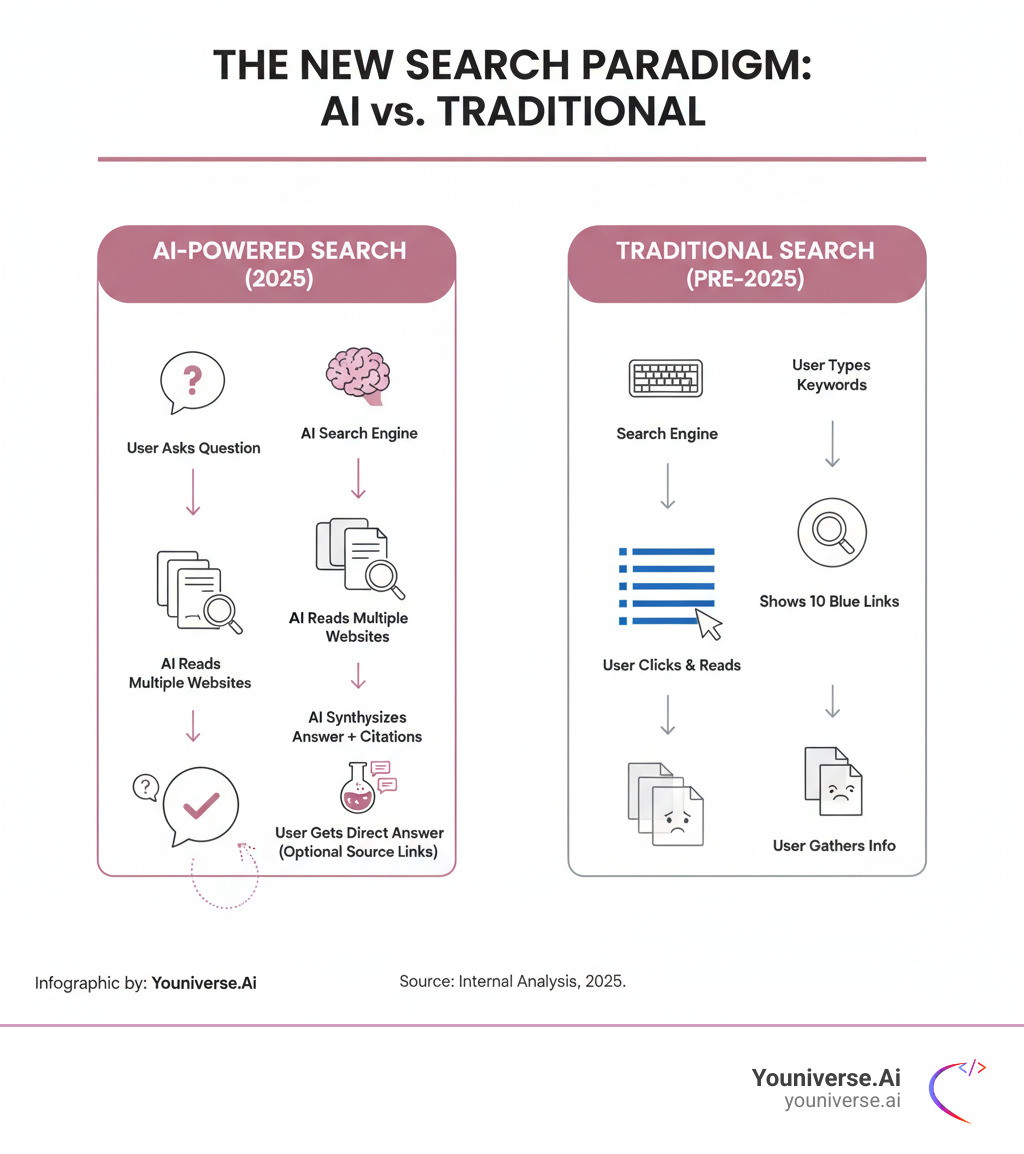
The New Search Paradigm: Why AI Changes Everything
For decades, "Googling" was our go-to, but this era is ending faster than most realize. Experts predict traditional search could lose 50% of its market share by 2028 as people go straight to AI for answers.
The AI search landscape is fundamentally different. Instead of ten blue links, users get direct, conversational answers synthesized from multiple sources. Large language models (LLMs) are being adopted at an incredible pace, changing how we find information forever.
This shift in user behavior creates a massive challenge: if your content isn't directly influencing these AI-generated answers, you're becoming invisible. With a growing number of zero-click searches, users get their answers without ever visiting your site. It's no longer just about being found; it's about being the answer AI chooses to share.
From Keywords to Concepts
Remember stuffing pages with keywords? Those days are gone. AI-driven search engines don't just match words—they understand meaning. They grasp user intent, contextual understanding, and the relationships between concepts. This is semantic search, powered by Natural Language Processing (NLP) that comprehends the nuances of human language.
This means your content needs to answer the real questions people are asking. Instead of just optimizing for "web hosting York PA," think about the underlying concerns. Are they worried about downtime? Confused about pricing? Trying to decide between managed or self-managed hosting?
AI connects these concepts and recognizes when your content provides genuine, comprehensive answers. This is where E-E-A-T (Experience, Expertise, Authoritativeness, and Trustworthiness) becomes critical. AI algorithms prioritize these signals, looking for real credentials and content that demonstrates deep knowledge. If you're writing about small business web hosting, you need to show you've actually worked with them. Share specific examples and demonstrate you understand their unique needs.
For more on these foundational principles, check out how SEO helps your site get found online.
The Rise of Generative Engine Optimization (GEO)
This new reality has created a new discipline: Generative Engine Optimization (GEO).
While traditional SEO focused on ranking in search results, GEO is about optimizing your brand visibility within AI responses. It's about ensuring that when AI platforms answer questions in your industry, they cite your content and present your brand as the authority.
The challenges are different. With direct answers replacing blue links, users might never click through to your site. You can't just pay for visibility in AI responses—there's no "sponsored" slot in a ChatGPT answer. This shifts everything to earned media and organic authority.
There's also the reputation management aspect. AI can present information with an authoritative tone, even when it's wrong. If outdated or negative information about your brand gets embedded in AI training data, it can spread without you knowing.
But here's the opportunity: research shows that up to 90% of citations driving brand visibility in LLMs come from earned media. Quality content and genuine expertise can directly influence what AI says about you. The future of SEO is about becoming the source AI trusts and cites.
Master GEO now, or risk becoming invisible in the age of AI search.
Content That Connects: Creating for Humans and AI Alike
In the AI era, your content needs to work double duty: it must resonate with people and make sense to algorithms. The goal is to become the source that AI trusts enough to cite and recommend. When ChatGPT or Google's AI Overview needs information, you want it pulling from your website.

AI models prioritize content that is comprehensive, accurate, and clearly presented. Generic articles won't cut it. AI values in-depth analysis and unique insights that demonstrate genuine expertise. If you're writing about web hosting, don't just list features. Share real client challenges and specific solutions that worked. This depth signals expertise to both humans and AI.
Best Practices for AI-Ready Content
Creating content for both audiences starts with clarity and usefulness.
- Write with Clarity: Use short paragraphs and bullet points. Break up dense information into digestible chunks. Aim for an eighth-grade reading level to ensure your content is accessible.
- Focus on User Intent: Before writing, ask, "What problem is my reader trying to solve?" Address that need directly. This naturally integrates related terms and gives AI richer context.
- Offer Unique Value: To stand out, you need a fresh perspective, original research, or personal experience. At Youniverse.Ai, when we write about AI-driven search optimization, we draw from real client implementations, not just theory.
- Update Old Content: Refresh articles from a few years ago with current information and new data. Use Google Search Console to find older pieces that still get traffic and deserve an update.
- Use AI Tools Responsibly: Google's guidance on AI-generated content is clear: using AI is fine if the result is helpful, original, and high-quality. Use AI as an assistant to brainstorm or draft, but always review, fact-check, and refine the output with your own expertise.
Structuring for Snippets and AI Overviews
To boost visibility, optimize for featured snippets and AI Overviews—the concise answers at the top of search results. The secret is structure. AI loves organized information.
Provide concise answers to specific questions, ideally in one or two clear sentences. Use lists and tables to make information scannable for both humans and algorithms, as they are frequently pulled into AI summaries. Your headings (H2s and H3s) act as signposts, helping AI understand your page's structure.
Most importantly, use schema markup. This structured data from Schema.org is like giving AI a detailed map of your content. The most valuable types for AI search include FAQPage, HowTo, Article, and Product. This markup makes your content eligible for rich results and prominent placement in AI responses.
Building 'Natural Human Authority'
In AI-driven search, trust is currency. AI algorithms prioritize credible sources, which is where E-E-A-T (Experience, Expertise, Authoritativeness, and Trustworthiness) becomes essential. The importance of E-E-A-T can't be overstated; it's the framework AI uses to evaluate your content.
- Author Credentials: Attribute content to a real person with a bio highlighting relevant experience.
- Consistent Publishing: Regularly releasing high-quality content establishes you as a thought leader.
- Backlinks and Mentions: Links and mentions from reputable sources signal authority to AI.
- Social Proof: Testimonials, case studies, and positive reviews provide evidence that real people trust you.
- Real-World Experience: Share actual stories and practical recommendations. This "Experience" component is what separates genuine experts from content farms. When we talk about helping businesses in Shrewsbury, PA or Red Lion, PA, we share real outcomes—that authenticity resonates.
Technical Mastery: Building a Foundation for AI-Driven Search Optimization
Think of your website as a house. No matter how great your content is, if the foundation is crumbling, the house won't stand. In AI-driven search optimization, technical SEO is that crucial foundation. AI crawlers are sophisticated, but they prioritize sites that are fast, secure, and easy to understand. If your site fails these basic tests, you're essentially invisible to the AI engines reshaping search.
The good news is that the technical factors AI prioritizes are the same ones that improve the experience for human users: efficiency, clarity, and trustworthiness.
The Critical Role of Structured Data
We've mentioned it before, but it's worth repeating: schema markup is a translator between your website and AI. By using structured data from Schema.org, you're explicitly telling AI what your content means. For example, FAQPage schema defines questions and answers, removing any guesswork.
This precision is invaluable. AI engines can confidently cite your content, making your pages eligible for rich results and more likely to appear in AI Overviews. At Youniverse.Ai, our AI website builder comes with preset markup, simplifying this crucial step.
Core Technical Factors for AI Prioritization
Beyond structured data, several technical elements are non-negotiable for AI visibility.
- Mobile Optimization: Most searches happen on phones. A responsive design that works flawlessly on any device is essential.
- Page Speed: AI values efficiency. Fast-loading pages are rewarded. Focus on Google's Core Web Vitals to measure and improve your site's performance.
- HTTPS Security: The padlock icon signals your site is safe, a critical trust factor for both users and AI.
- Clean URL Structure: Logical, human-readable URLs (e.g.,
youniverse.ai/high-frequency-wordpress-hosting/) help crawlers understand your site's organization. - Crawlability and Indexability: Ensure AI bots can find and understand your content with a well-structured
robots.txtfile, an XML sitemap, and strong internal linking.
For businesses using WordPress, our High-Frequency WordPress Hosting is designed to deliver the speed and security that both AI crawlers and human visitors demand. Technical excellence isn't glamorous, but it's the platform on which all AI visibility is built.
Winning the AI Race: Advanced Strategies and Measurement
The shift to AI-driven search isn't just about keeping up—it's about getting ahead. Brands that establish authority early in AI search create a compounding advantage that's incredibly difficult for latecomers to overcome. Being first to establish your narrative within AI systems means you're setting the baseline, creating a virtuous cycle of visibility. The first-mover advantage in AI-driven search optimization is real and measurable.
As we optimize for AI, we must also commit to ethical considerations. Ensuring our content is accurate, unbiased, and genuinely helpful matters more than ever, as AI can amplify misinformation.

Leveraging AI Tools for Smarter SEO
AI tools aren't replacing SEO professionals; they're making us better. They handle the heavy lifting of data analysis and repetitive tasks, so we can focus on strategy and creativity.
- Content Generation Tools: Use tools like ChatGPT to brainstorm ideas or draft outlines, but always bring your expertise to the table. Review and refine their output to ensure it demonstrates real E-E-A-T.
- SEO Analysis Platforms: Modern AI-powered tools can identify content gaps, predict trends, and analyze competitor strategies with remarkable precision.
- Keyword Research with AI: Instead of just looking at search volume, we can now understand semantic relationships and predict user intent. Start with Google's Keyword Planner and improve it with AI-powered tools.
- Voice Search Optimization: Optimize for how people speak, not just how they type. Incorporate conversational, natural-language phrases to capture voice search queries.
A New Scorecard: AI-Centric Metrics for Success
Traditional metrics like traffic and rankings are still important, but they don't tell the whole story. In the age of zero-click searches, we need new ways to measure success.
- Snippet Performance Tracking: Monitor how often your content appears in featured snippets and AI Overviews. These are prime positions that often get cited by AI.
- Citation Monitoring: Track how often AI platforms like ChatGPT and Gemini reference your content. This is the new frontier of measuring influence.
- Brand Mention Volume in LLMs: Even without a direct link, how often is AI discussing your brand? This indicates your overall authority in the AI ecosystem.
- Voice Search Analytics: Use Google Search Console to see traffic from voice-enabled devices and gauge the effectiveness of your conversational content.
The Future of AI-Driven Search Optimization
The future of search is unfolding fast, with predictions that traditional search could lose 50% of its market share by 2028. Emerging trends point toward more sophisticated conversational AI, hyper-personalization of results, and a growing need for transparency in how AI sources information.
Predictive analytics will help us anticipate search trends, giving early adopters a massive advantage. The brands that thrive will be the ones that adapt fastest. At Youniverse.Ai, our AI Search Visibility Engine (AEO) is built for this future, ensuring your content is prominent across all the AI platforms that matter.
Frequently Asked Questions about AI Search Optimization
Will AI replace SEO?
No, AI is changing SEO, not replacing it. The core mission of providing value and a great user experience remains the same, but the tactics and tools are evolving. SEO professionals who adapt will become more strategic, using AI to handle data analysis while they focus on high-level strategy, creativity, and building authentic connections. As long as people search for information, SEO will be essential.
How can I see if my content is being used by AI?
Tracking your visibility in AI is becoming easier. Here's how:
- Test it yourself: Ask ChatGPT, Gemini, or Perplexity questions that your content answers. See if your site is cited in the responses.
- Monitor analytics: Look for referral traffic from AI platforms.
- Use specialized tools: New platforms are emerging that are designed to track brand and content citations within AI-generated answers and overviews.
Starting to track these metrics now will give you a significant advantage in understanding your AI search performance.
Is it okay to use AI to write content?
Yes, but with a major caveat: quality is paramount. Google's guidance on AI-generated content is clear: they reward high-quality, original, and helpful content that demonstrates E-E-A-T (Experience, Expertise, Authoritativeness, and Trustworthiness), regardless of how it was created.
Use AI as a collaborative tool. It can help draft outlines, generate FAQs, or suggest angles. However, every piece of AI-assisted content must be reviewed, fact-checked, and refined by a human expert. The combination of AI's efficiency and a human's judgment, creativity, and real-world experience is where AI-driven search optimization truly shines.
Conclusion: Adapt and Thrive in the Age of AI Search
The future of search is here. AI-driven search optimization represents a fundamental change in how people find information, and it's an incredible opportunity for businesses willing to adapt early. While others are still figuring out what's happening, you can position your brand as a trusted authority in this new landscape.
By embracing Generative Engine Optimization (GEO), you're not just chasing rankings—you're becoming the answer that AI platforms cite. By creating high-quality content structured for AI and demonstrating real expertise, you're building authority that both humans and algorithms recognize and trust.
This is exactly why we built Youniverse.Ai. Our AI Search Visibility Engine (AEO) is designed from the ground up to help your website thrive in a world where ChatGPT, Gemini, and AI Overviews are the new front page. We understand how to position your expertise where it matters most.
Traditional SEO has evolved. It's time to master this new landscape with Answer Search Optimization, where authority, quality, and technical excellence create unbeatable visibility.
The age of AI search has arrived. Let's make sure your business is leading it.