


AI content optimization: 5 Steps to Dominate!
Why AI Content Optimization Is the Future of Digital Visibility
AI content optimization is the practice of structuring and writing your content so it gets selected, cited, and featured by AI-powered search engines and chatbots like ChatGPT, Google AI Overviews, and Perplexity. Unlike traditional SEO that focuses on ranking your page in a list of links, AI optimization ensures your specific answers appear directly in AI-generated responses.
Quick Answer: The 5 Steps to AI Content Optimization
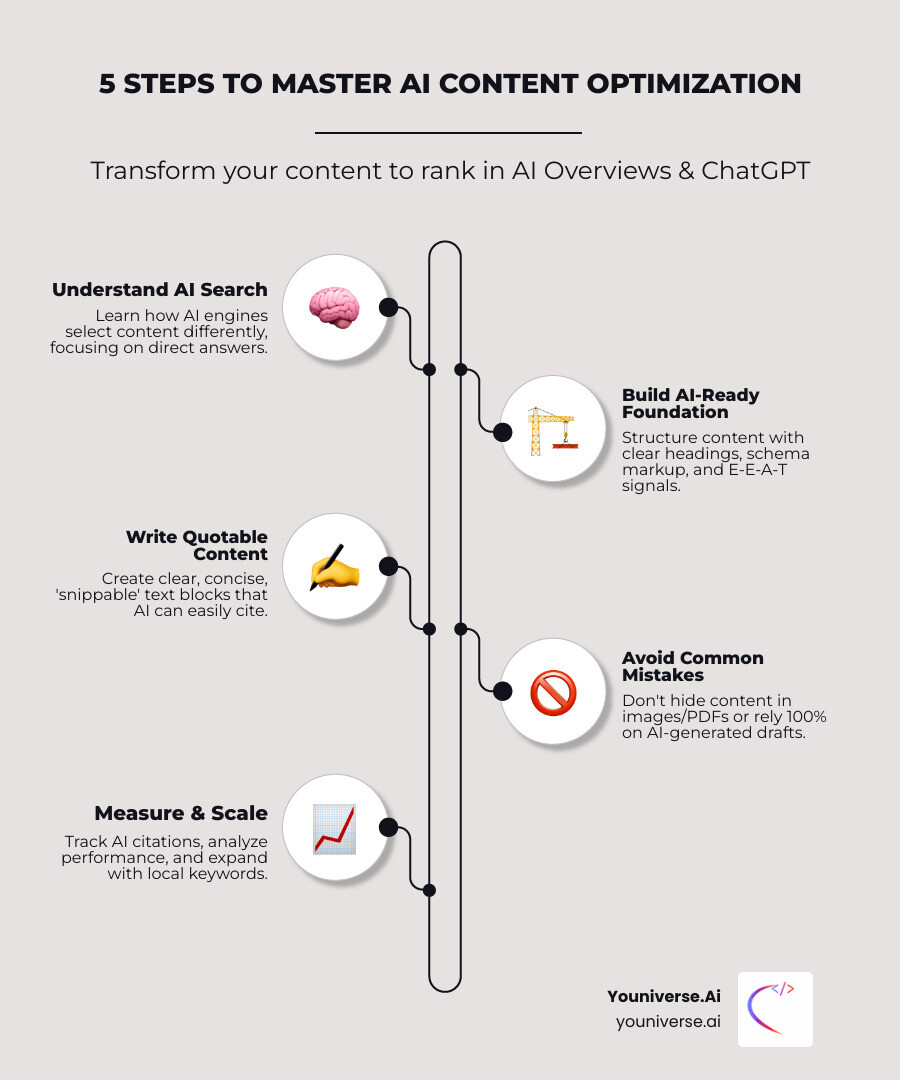
- Understand the AI Search Landscape – Learn how AI engines select content differently than Google.
- Build an AI-Ready Foundation – Structure content with clear headings, schema markup, and E-E-A-T signals.
- Write Clear, Quotable Content – Create "snippable" text blocks that AI can easily cite.
- Avoid Common Mistakes – Don't hide content in images or rely 100% on AI-generated drafts.
- Measure and Scale – Track AI citations and expand your strategy with local keywords.
This isn't just a trend—it's a seismic shift. AI referral traffic to top websites spiked 357% year-over-year in June 2025, and over 67% of users now start their research on AI platforms instead of Google. For local businesses in places like York, PA, this is a massive opportunity. When someone asks ChatGPT, "What's the best AI agency in York PA?" you want your business to be the answer, not just a link.
The good news is that the strategies in this guide are practical and actionable. While traditional SEO is still the foundation, AI optimization is the new frontier. Early adopters are seeing 3.2x more citations than competitors. The window to dominate your local niche is open, but it won't stay that way forever.
Step 1: Understand the New Landscape of AI-Driven Search
Think about the last time you asked ChatGPT a question. You didn't scroll through ten blue links—you got a direct answer, maybe with a source cited at the bottom. We're moving from a world where Google gives you a list of websites to one where AI systems like ChatGPT, Perplexity, and Google's AI Overviews simply give you the answer. Your content either gets selected and cited, or it's invisible. This is the core of Generative Engine Optimization (GEO)—the evolution of SEO.
What is AI Content Optimization and Why Does It Matter Now?
In simple terms, AI content optimization means structuring and writing your content so AI systems can easily understand, trust, and choose it to answer user questions. It's not about tricking algorithms; it's about being crystal clear and helpful.
While traditional SEO aims to rank your entire page, GEO and AEO (Answer Engine Optimization) focus on getting specific pieces of your content extracted and quoted directly in AI responses. When someone in York, PA, asks, "What's the best AI agency near me?" you want the AI to cite your business with confidence.
The numbers are staggering: AI referral traffic is exploding, with visits from AI sources jumping 357% year-over-year in June 2025. If your content doesn't appear in the AI-generated summary, most users will never see it. This is why you need to rank in AI answers, not just search results. For businesses searching for "AI optimization York PA," understanding this shift is step one. Want to dive deeper? Check out our complete guide on AI-driven search optimization.
The Core Benefits: Speed, Scale, and Smarter Insights
Adopting AI content optimization open ups three game-changing advantages.
Efficiency is the first big win. AI can handle time-consuming work like keyword research and competitor analysis in minutes, not hours. This frees up your team to focus on strategy and creativity instead of drowning in spreadsheets.
Scalability comes next. AI lets you increase content production without hiring an army of writers. While human oversight is crucial, AI can draft outlines, generate initial content, and create images, allowing your experts to produce significantly more high-quality work. For a local business in Harrisburg, PA, or Lancaster, PA, this levels the playing field.
Smarter, data-driven insights might be the most powerful benefit. A fascinating 41% of marketers use AI for insights, surfacing patterns that would take humans weeks to find. AI can analyze your content, spot gaps your competitors are filling, and predict which topics will perform best before you write a single word. It's like having a crystal ball for your content strategy, giving you a clear roadmap for improvement.
Step 2: Build an Unshakeable, AI-Ready Foundation
AI models are like picky eaters—they prefer well-structured, trustworthy, and technically sound websites. Here's how to prepare the perfect meal.

Structure Your Content for Easy Digestion
AI systems are speed-readers on a mission: find the exact answer, fast. This means content structure is king for AI content optimization. Clear headings (H2s, H3s) act as a roadmap, helping AI zero in on what it needs. For example, a heading like "AI Optimization Services in York PA" is a direct signal.
Q&A formats are pure gold because AI engines are built to answer questions. I also rely heavily on bulleted and numbered lists to break down complex ideas and tables to present data or comparisons. When you make content scannable for both humans and bots, everyone wins. Your readers get information faster, and AI gets the clear signals it needs to cite your content.
Build Trust with E-E-A-T and Schema Markup
AI systems prioritize sources that demonstrate credibility. This is where Google's E-E-A-T framework is your secret weapon. You must actively demonstrate your E-E-A-T signals in your content.
Always include detailed author bios that highlight relevant experience, especially local expertise for areas like Lancaster or Harrisburg, PA. Also, be sure to cite credible sources by linking to authoritative reports and studies to show you've done your homework.
On the technical side, structured data (schema markup) is like giving AI a cheat sheet to your content. The crucial role of structured data can't be overstated. By using schema.org to label your content as a product, FAQ, or local business, you're translating it into a language machines understand perfectly, making it easier to extract and cite.
Finally, you must ensure your site is crawlable for AI crawlers like GPTBot and PerplexityBot. They need clean, fast access to your content. That's why at Youniverse.Ai, we run everything on High-Frequency WordPress Hosting optimized for speed and reliability. A fast, technically sound website isn't just good for users—it's foundational for AI visibility. If an AI crawler has to wait for your page to load, you're invisible.
Step 3: Write Clear, "Snippable" Content AI Loves to Quote
To get cited in an AI answer, your content needs to be quotable. This means writing with clarity, precision, and authority.
Master the Art of Clarity and Conciseness
AI systems are obsessed with clarity. If your writing is convoluted or full of jargon, AI will skip it and find a clearer answer elsewhere. Aim for short sentences (15-20 words) and simple language. As peer-reviewed studies show, clarity wins, making your content easier for AI to parse and cite.
Structure your writing in short, factual blocks of 2-4 sentences. This creates digestible chunks that AI can easily process and extract. Most importantly, answer the main question immediately. I call this the "Bottom Line Up Front" approach. If the topic is "What is AI content optimization?" define it in the first sentence. AI systems and human readers both reward this directness.
Create "Citation-Ready" Snippets
Your content needs to be "snippable"—meaning it works perfectly even when pulled out of context. When ChatGPT or Perplexity quotes you, they're extracting a sentence or two, so those sentences must stand on their own.
A powerful tactic is using specific data points and statistics. In fact, content with data points is 30-40% more likely to be cited by AI. Instead of saying "traffic is growing," say "AI referral traffic spiked 357% year-over-year." This specificity is both quotable and credible.
Focus on self-contained phrasing, where each key sentence answers a micro-question completely. Also, target long-tail, conversational keywords. People ask AI full questions like, "What is the best AI agency in York PA?" or "How can I optimize my site for AI search?" Structuring content around these natural queries dramatically increases your chances of being selected.
To streamline this, I often use an SEO Optimized AI Content Generator to draft initial ideas and ensure keyword integration. It's not about letting AI write everything—it's about using it as a smart starting point that I can then refine and humanize. AI content optimization is about writing so clearly that AI has no choice but to cite you.
Step 4: Sidestep Common AI Content Optimization Mistakes
Navigating AI optimization means knowing what not to do. Avoid these common traps that can make your content invisible.
Don't Let the Robot Drive Blindly
AI tools are brilliant assistants but terrible bosses. Blindly implementing AI suggestions without human review often results in robotic content, factual errors ("hallucinations"), or a mismatched brand voice. AI content optimization must be a partnership, not a handoff.
Your expertise is your advantage, especially for local businesses in York, PA, or Harrisburg, PA. Don't sacrifice that authenticity by prioritizing keywords over the human experience. AI is getting smarter and rewarding content that genuinely helps people.
Never rely 100% on AI for net-new content. Use it to draft, outline, and brainstorm, but the final product must come from human experts with real-world experience. AI models recognize and prioritize content with strong E-E-A-T signals, which only come from genuine human expertise. The human-in-the-loop is non-negotiable.
Avoid Technical and Formatting Traps
Even with a great strategy, technical mistakes can torpedo your AI visibility. Here are the most common pitfalls:
- Hidden Content: Don't hide key information in tabs or accordions. AI crawlers may not render or see content that requires a click, meaning it can't be cited. Keep your most quotable information visible.
- Trapped Information: Avoid putting crucial stats or answers exclusively in images or PDFs. AI struggles to read text in images and finds PDFs harder to crawl than standard HTML. Always include that information in your main body text.
- Vague Language: Long, meandering sentences and complex vocabulary make it hard for AI to extract a clean, "snippable" quote. Be direct and clear, making every sentence capable of standing on its own.
- Forgetting Brand Voice: It's easy to lose your unique personality when using AI. If you're an AI agency in York, PA, your local expertise should shine through. Use AI to scale your voice, not erase it.
For more detailed guidance, check out Optimizely's insights on Using AI for content optimization: Dos and don'ts. You can also explore our Blog for more practical tips.
Step 5: Measure Your Success and Scale Your Strategy
You can't improve what you don't measure. Here's how to track your AI visibility and scale your efforts for maximum impact.
How to Track Your AI Visibility
Measuring AI content optimization isn't as simple as checking Google rankings, as AI platforms don't offer analytics dashboards. You have to get creative.
First, check Google Analytics for AI referral traffic. Look for visitors from domains like chat.openai.com and perplexity.ai. This gives you a sense of how much traffic AI engines are sending your way. You can learn more about monitoring these AI crawlers and their behavior.
Honestly, the most revealing method is manual checking. I regularly search my target keywords and questions directly in ChatGPT, Gemini, and Google's AI Overviews. I test queries like "best SEO services in Harrisburg PA" and branded questions like "What does Youniverse.Ai do?" If our content is missing or incorrect, it's a signal to update it immediately. This is exactly how to rank my site in AI: constantly monitor what AI says about you and adjust accordingly.
Scaling Your Efforts for Local and Niche Dominance
Once you know what's working, it's time to scale. This starts with continuous content gap analysis to identify emerging topics or areas where your content is thin. AI tools can help surface these opportunities quickly.
For local businesses, scaling means doubling down on hyper-local keywords. If you're in York, PA, you need content optimized for "AI agency York PA" and "AI optimization York PA." When someone asks ChatGPT a local question, you want to be the answer.
I've also learned that knowing when to partner with experts makes all the difference. The technical demands of AI optimization—from schema markup to crawler management—can quickly overwhelm an in-house team.
That's why we built our managed SEO AIO service at Youniverse.Ai. We handle everything end-to-end: continuous upgrades, AI-driven on-page improvements, automated backlink growth, and the crucial AI visibility layer to help you rank on Google and get cited by ChatGPT and Perplexity. You get a simple live dashboard and weekly reports, all running on our optimized cloud WordPress hosting. This lets you focus on your business while we ensure you dominate both traditional and AI-driven search.
Frequently Asked Questions about AI Content Optimization
I get asked about AI content optimization all the time, especially from local business owners. Here are the most common questions.
How is AI content optimization different from traditional SEO?
Think of it this way: traditional SEO tries to rank your entire page in a list of blue links. AI content optimization (or GEO—Generative Engine Optimization) focuses on getting specific, "snippable" pieces of your content selected and cited directly within AI-generated answers on platforms like ChatGPT or Google AI Overviews. It's not a replacement for SEO; it's the next evolution, adding a focus on structure, clarity, and quotability to existing SEO fundamentals like E-E-A-T.
How long does it take to see results from AI optimization?
Results vary, but many businesses see their content in AI citations within a few weeks to a couple of months, especially when publishing new, well-structured content that answers common questions. Since AI models often rely on pages that already rank well—over 50% of Google AI Overview citations come from pages in the top 10—improving your core SEO can speed up your AI visibility. For local businesses in York, PA, targeting specific local questions can yield even faster results.
Do I need to be a technical expert to optimize for AI?
Absolutely not! While technical details like schema markup and site speed are important, the core of AI optimization is about creating clear, helpful, and well-structured content. It's more about communication than code. If you write directly for your audience, answer their questions concisely, and organize your content with logical headings, you're 80% of the way there.
Of course, if you want to automate the entire process and ensure no technical detail is missed, a managed service like Youniverse.Ai can handle everything from schema implementation to AI crawler management, letting you focus on your business.
Conclusion: Your Future in Search Starts Now
Mastering AI content optimization isn't about chasing algorithms. It's about creating the most helpful, authoritative, and accessible content on the web. When you focus on that, visibility in both traditional and AI search tends to follow.
By following these five steps, you're future-proofing your digital presence for how people will find information tomorrow. Whether someone is asking Google, ChatGPT, or Perplexity, your content will be there, ready to answer.
I know this can feel overwhelming, especially when you're running a business in York, PA, or Lancaster, PA. That's exactly why we built Youniverse.Ai. For businesses ready to automate this process, our managed system handles everything: on-page AI optimization, automated backlink growth, and an AI visibility layer to ensure you rank on Google and get cited by AI platforms. You get a simple live dashboard and weekly reports, all running on our optimized cloud WordPress hosting.
If you're just getting started, our Youniverse Cloud plan at $19/month includes our fast, easy-to-use AI cloud website builder, giving you a powerful all-in-one foundation from day one.
The window to dominate your niche in the age of AI is open right now. Businesses optimizing for queries like "AI agency York PA" and "how to rank my business in ChatGPT" are the ones who will own their markets for years to come.
Ready to own your niche? Explore the all-in-one solution and let's make your content impossible to ignore.