


AI ecommerce websites: Top 5 for 2025
Why AI Ecommerce Websites Are Changing Online Selling
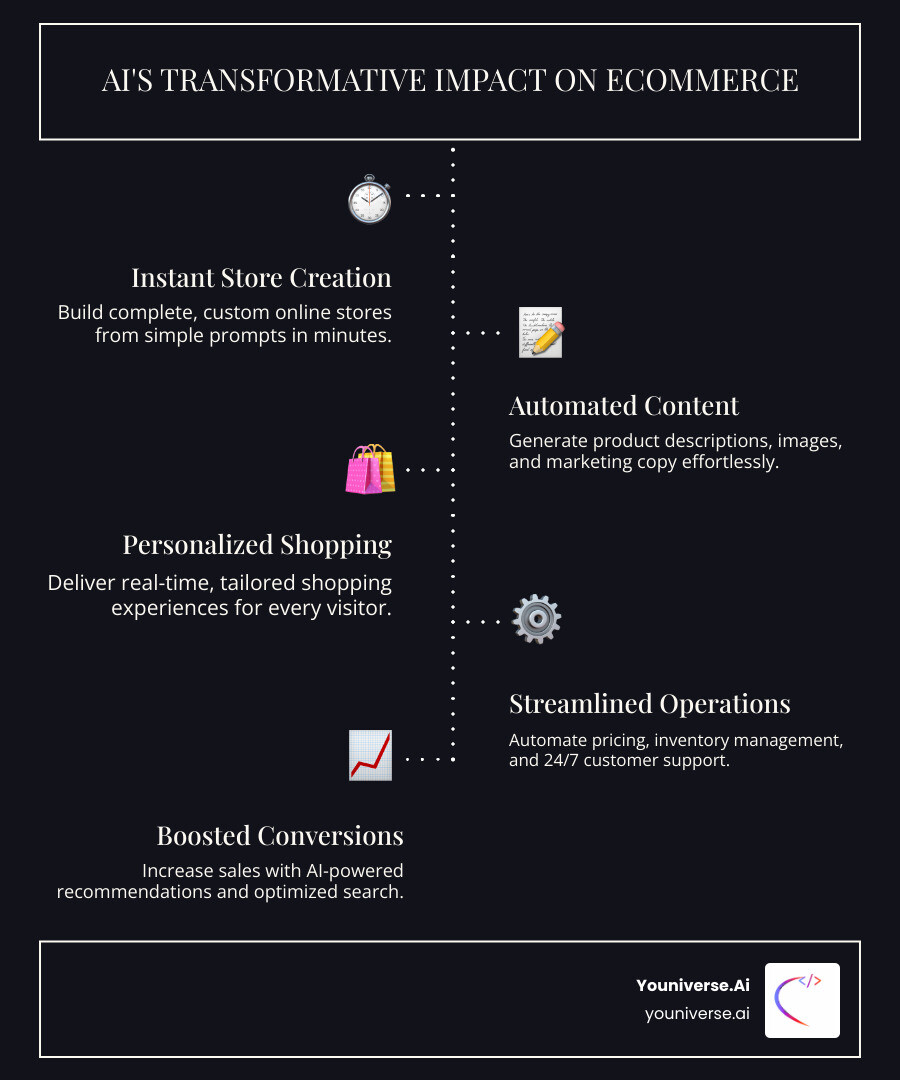
AI ecommerce websites use artificial intelligence to automate and optimize every aspect of running an online store—from building your site in minutes to personalizing customer experiences and managing inventory. Here's what AI can do for your ecommerce business:
- Build complete stores in under 5 minutes using simple text prompts
- Generate product descriptions, images, and marketing copy automatically
- Personalize shopping experiences for each visitor in real-time
- Automate pricing, inventory, and customer support 24/7
- Boost conversions with AI-powered recommendations and search
We're living through a revolution in online selling. With an estimated 2.14 billion people worldwide buying goods and services online, the ecommerce landscape has never been more competitive—or more accessible. AI has completely redefined what "easy" means for building and running an online store.
Just a few years ago, launching an ecommerce website meant weeks of design work, expensive developers, and constant technical maintenance. Today, AI-powered platforms can generate a fully functional online store—complete with custom design, SEO-optimized product descriptions, payment processing, and advanced features like appointment booking—in under three minutes.
But AI doesn't stop at building your site. It's changing how you find customers, serve them, and keep them coming back. From appearing in ChatGPT shopping results to personalizing every visitor's experience, AI gives local businesses the same sophisticated tools that enterprise retailers use—without the enterprise price tag or complexity.
This guide shows you exactly how AI ecommerce websites work, which platforms deliver real results, and how to leverage AI to rank in both Google and AI platforms like ChatGPT. Whether you're launching your first store or upgrading an existing one, you'll learn practical strategies that drive traffic and sales without complicated tools or constant maintenance.
How AI is Revolutionizing Ecommerce Website Building
Imagine being able to tell a computer exactly what kind of online store you envision, and then watching it materialize before your eyes in a matter of minutes. That's the magic AI brings to ecommerce website building. It's truly a game-changer, especially for busy entrepreneurs and small business owners in places like York, PA, or Lancaster, PA, who need to get online fast without sacrificing quality.

The sheer productivity boost and time-saving potential are incredible. AI has redefined the very concept of "easy" for no-code ecommerce builders, with platforms that generate unique designs, write SEO-optimized copy, and even set up complex features—all based on simple prompts. No longer do you need to spend countless hours wrestling with design elements or writing product descriptions. AI takes care of the heavy lifting.
Of course, the quality of output from AI website builders can vary. While some platforms can generate a complete store with specified color schemes, built-in appointment booking tools, and FAQ pages in just a few minutes, others might still require a fair bit of manual tweaking. But even with these variations, the efficiency gains are undeniable.
It’s crucial, however, to understand the difference between basic automation and true AI. Many platforms offer automated templates or drag-and-drop features, which are helpful but not truly "AI-powered." True generative AI goes much further. It leverages complex algorithms and vast web data to generate outputs—including images and text—that are uniquely relevant and personalized to each user prompt. This isn't just filling in blanks; it's creating something new and custom. If you're wondering what makes a website builder truly effective, I encourage you to read more about it here: What Makes a No-Code Website Builder Effective?.
From Prompt to Professional Store in Minutes
I've seen it firsthand: the ability of generative AI to turn a simple text prompt into a fully fleshed-out online store is nothing short of amazing. You describe your business, your aesthetic, and your functional needs, and the AI gets to work. It crafts unique layouts, writes SEO-optimized copy for your products, and even sets up complex features like booking systems or customer testimonials.
For instance, Ucraft Next's UC Copilot was able to generate a complete store, including a specified color scheme, built-in appointment booking tool, ease-of-care messaging, testimonials, requested typography, and an FAQ page, all in a mind-boggling 2.3 minutes. Wix's AI Website Builder can generate a preliminary website layout custom to user responses in about 2 minutes. This speed means that the time-to-market for a new online business is drastically reduced, allowing entrepreneurs in Shrewsbury, PA, or Red Lion, PA, to launch their dreams faster than ever before.
The quality of output from these AI builders, when compared to traditional methods, can be remarkably high. While a human designer might still offer a more bespoke touch, AI delivers a professional, functional, and aesthetically pleasing site that would have taken days or weeks to achieve manually. For many businesses, this level of efficiency and quality is more than sufficient to get started and succeed.
Beyond Automation: What True AI Brings to the Table
Let's be clear: not all "AI-powered" tools are created equal. There's a significant difference between basic automation and the sophisticated intelligence of true generative AI. Basic automation often relies on predefined rules and templates. Think of it like a macro in a spreadsheet—it performs a set series of actions. Useful, but not intelligent.
True AI, on the other hand, operates on complex algorithms and analyzes vast amounts of web data to generate outputs that are uniquely relevant to your specific prompt. It's like having a highly creative and knowledgeable assistant who understands context, learns from patterns, and can produce original content. This isn't just about selecting a template; it's about crafting a unique digital storefront that reflects your brand's identity and meets your specific needs.
This distinction is key. While many platforms offer helpful automated features, true generative AI is what genuinely improves the ecommerce website building process. It's what allows for personalized product descriptions, unique image generation, and intelligent layout suggestions that adapt to your business, rather than you adapting your business to a rigid template.
Top AI Ecommerce Website Builders in 2025: A Comparison
Choosing the right AI ecommerce website builder is crucial for your online success. In 2025, the market is buzzing with innovative platforms, each offering a unique blend of AI capabilities. Here's a quick overview of some top contenders:
| Platform | Primary AI Features | Ease of Use | eCommerce Capabilities | Best For |
|---|---|---|---|---|
| Ucraft Next | UC Copilot (full site generation from prompt), AI image/copy/SEO tools | Excellent | Comprehensive (payments, inventory, fulfillment) | All-in-one AI-powered solutions, speed |
| 10Web | AI Builder (custom content/images), AI Co-Pilot (editing), automated maintenance | Excellent | WordPress/WooCommerce based, full online store features | WordPress users, comprehensive AI store building |
| Shopify | Shopify Magic (product descriptions, content), Sidekick (commerce assistant) | Good | Robust, scalable for established retailers | Established retailers, strong backend |
| Wix | AI Website Builder (layout), AI image editor, product descriptions, recommendations | Excellent | Good for small to medium stores, design freedom | Design flexibility, smaller businesses |
| Squarespace | AI builder (starting point), Design Intelligence | Good | Boutique businesses, aesthetically driven stores | Boutique brands, visual appeal |
For All-in-One Power: Ucraft Next & 10Web
When it comes to building an entire AI ecommerce website from the ground up with minimal effort, Ucraft Next and 10Web truly stand out. They embody the promise of AI-driven website creation, offering comprehensive solutions that go beyond simple assistance.
Ucraft Next's UC Copilot, as I mentioned, can spin up a fully functional store in just 2.3 minutes. This isn't just a basic template; it's a store custom to your specifications, including complex features like appointment booking. After that lightning-fast start, the additional setup time for our test store was a mere 48 minutes. That's a significant productivity gain!
Similarly, 10Web's AI Ecommerce Website Builder uses AI to create custom store content and images. Their AI Co-Pilot then assists with editing and customization, making the process incredibly intuitive. It also boasts features like AI-generated product descriptions and automated store maintenance. It's no wonder that over 1.5 million websites have been created with 10Web AI. For those looking for robust hosting to power their AI-generated WordPress sites, our High-Frequency WordPress Hosting offers the speed and reliability these advanced platforms demand.
For Established Retailers: Shopify
Shopify has long been a titan in the ecommerce world, and its adoption of AI has only strengthened its position. While its AI capabilities might not build an entire site from a single prompt like some newer players, Shopify excels in enhancing the core ecommerce experience for established retailers.
Shopify Magic is a suite of free, AI-enabled features integrated across Shopify's products. This includes tools that help write compelling product descriptions, suggest keywords, and guide you through pricing and categorization. These features are invaluable for optimizing your product listings and marketing efforts.
Moreover, Shopify offers Sidekick, the commerce assistant that is built into every Shopify Admin. Sidekick acts as your very own Shopify expert, guiding you with custom, skilled advice to make you more productive and successful. While Shopify provides robust backend ecommerce features, some users find its design freedom a bit limited compared to more flexible builders. Nevertheless, for businesses focused on scaling and managing complex operations, Shopify remains a top choice.
For Design Flexibility: Wix & Squarespace
If design aesthetics and creative control are paramount for your AI ecommerce website, then Wix and Squarespace are excellent contenders. They combine user-friendly interfaces with AI tools to help you create visually stunning online stores.
Wix is known for its intuitive drag-and-drop functionality and extensive template collection. Its AI Website Builder generates a preliminary layout custom to your responses in about 2 minutes, giving you a strong starting point. Wix goes further with its AI features, offering an AI image editor, AI product descriptions, and AI product recommendations, all designed to boost efficiency and sales. For businesses in Harrisburg, PA, who value design, Wix offers fantastic tools to design your store.
Squarespace, often favored by boutique businesses and creatives, also offers an AI website builder. While its AI is currently more limited in customization and acts more as a starting point (with additional setup potentially taking up to 3 hours), its Design Intelligence toolkit can still help you craft an aesthetically pleasing online store. These platforms allow for a high degree of visual personalization, ensuring your brand's unique style shines through.
Essential AI Features for High-Performing AI Ecommerce Websites
Beyond the initial website build, AI plays a pivotal role in optimizing every facet of your online business. From enhancing customer experience to driving marketing efforts and streamlining operations, AI is the engine behind a truly high-performing AI ecommerce website. I've seen businesses in Towson, MD, and beyond leverage these tools to incredible effect.
Real-world examples abound: Allbirds used AI to automate highly personalized repurchase emails, increasing their conversion value. Walmart is making huge strides in the AI space with its in-house open-source AI tool that reads Walmart-specific queries more deeply, putting more time back in customers' hands. Zara uses AI solutions to understand customer preferences, leveraging technology to convert shopping behavior into actionable data, allowing for real-time adjustments in production and sales. These aren't just big tech companies; these are strategies that can be adapted for any business looking to gain an edge.
Boosting Sales with AI-Powered Marketing and SEO
AI is a marketer's best friend. It transforms how we connect with customers and optimize our online presence.
- AI-driven personalization: Brands enabling AI-powered ecommerce are 23 times more likely to acquire new customers and 19 times more likely to achieve above-average profitability. Personalized email content, for example, has 29% more unique open rates and 41% more unique click rates. AI allows for tailoring every interaction.
- Dynamic pricing: This is a huge one. Approximately 55% of retailers plan to pilot some form of real-time AI-based dynamic pricing system in 2025. AI assesses evolving data, like competitor prices and demand, to suggest optimal prices automatically. Amazon has even used dynamic pricing to boost profits by 25%.
- Customer segmentation: AI makes it possible to automate customer segmentation, revealing insights hidden in your data and leading to a 760% increase in revenue for targeted campaigns.
- AI-Driven Search Optimization: To truly stand out, you need more than just traditional SEO. AI helps you analyze complex search queries and user intent. For a deeper dive, check out my guide on AI-Driven Search Optimization: The Complete Guide.
- AI for product descriptions: AI tools can create compelling product descriptions by considering customer reviews, product category, and customer segment. Shopify's AI product page generator is a prime example of this efficiency, helping you craft SEO-optimized copy in a fraction of the time.
- Voice search optimization: In the US alone, 49% of shoppers use voice search for shopping, and 60% shop with smart home assisted devices. Optimizing your site for voice search with AI-powered natural language processing is no longer optional; it's a necessity. You can learn more about this trend here: 49% of shoppers use voice search.
- Cart recovery: AI allows for smarter cart recovery strategies. Industry leaders are able to retrieve 10% to 14% of abandoned carts, with 45% of cart recovery emails being opened and 21% of them being clicked. AI can personalize these recovery efforts for maximum impact.
For businesses looking to dominate search results, both traditional and AI-powered, an SEO Optimized AI Content Generator is a must. This is where AI-driven on-page improvements come into play, helping your content rank not just on Google, but also within emerging AI platforms.
Enhancing the Customer Journey
The customer journey is where AI truly shines, creating seamless and personalized experiences that keep shoppers coming back.
- Personalized recommendations: AI-powered recommendations are incredibly effective, delivering a 10-15% revenue lift and making customers 92% more likely to buy additional products. From suggesting complementary items to offering custom product sorting, AI ensures every customer feels seen and understood.
- AI chatbots: 73% of shoppers believe AI would improve their customer experience. AI-powered chatbots can handle almost 14% more inquiries per hour, providing instant, 24/7 support. Platforms like IBM watsonx for retail enable customers to self-serve a wide range of queries, supporting accurate routing to human agents and delivering highly personalized, contextually relevant shopping experiences.
- Virtual try-ons: For fashion and beauty brands, AI-powered virtual try-ons are a game-changer. They can lead to a 33% increase in average order value (AOV) by giving customers confidence in their purchase decisions.
- Sentiment analysis from reviews: 4 in 10 shoppers use reviews as their main channel of online research. AI can analyze these reviews for common complaints, preferences, and requests, helping you understand customer sentiment and improve products.
Streamlining Backend Operations for your AI ecommerce websites
AI extends its magic far beyond the customer-facing side, bringing unprecedented efficiency to your backend operations.
- Inventory management: Real-time tracking powered by AI can reduce stockouts by at least 30%. AI is used for stock prediction around seasonal variations, flash sales, and product launches, ensuring you always have the right products at the right time.
- Order fulfillment: AI can optimize logistics, predict delivery times, and even help map out more sustainable delivery routes.
- Payment processing: While complex, AI website builders handle advanced ecommerce functionalities, including secure payment processing and order fulfillment, often integrating with trusted third-party providers.
- Fraud detection: AI algorithms continuously monitor transactions and user behavior to identify suspicious patterns, flagging potential fraud before it impacts your business. This is crucial for maintaining trust and protecting your revenue.
For businesses that want to ensure their entire online presence, including their content, is optimized and managed with AI, exploring an AI Content Website can offer a significant advantage.
Strategic Considerations for Your AI Ecommerce Website
Adopting AI for your online store is a strategic move that requires careful thought. It's like standing at a crossroads, with many exciting paths ahead. How do you choose the right direction, especially when considering the unique needs of a business in, say, Harrisburg, PA, or Lancaster, PA?
You need to consider several factors: selecting the best builder, understanding cost implications, ensuring robust security, navigating ethical concerns, and preparing for the future trends in AI.
Choosing the Right Builder and Preparing for the Future of Search
When evaluating AI ecommerce websites builders, I always recommend a few key criteria:
- Is it genuinely AI-powered? Does it use true generative AI, or is it just advanced automation?
- Does it offer essential ecommerce features? Think payment processing, inventory, and analytics.
- Does it significantly reduce workload and save time? This is a core promise of AI.
- Is it easy to use? A steep learning curve defeats the purpose of AI assistance.
- What's the quality of the output? Does the final store look professional and perform well?
Beyond these, consider your specific business goals and must-have features. Do you need extensive customization? Will you be scaling rapidly?
And here's a critical point for the future: preparing for the future of search. With platforms like ChatGPT, Gemini, and Perplexity increasingly influencing product findy, you need to understand how to rank your business in ChatGPT and other AI platforms. This involves optimizing your site for AI crawlers like OAI-SearchBot, implementing Product schema markup, uploading products to Google Merchant Center, and ensuring high-quality visuals and reviews. This is where an AEO Digital Marketing strategy becomes indispensable. If you're looking for specialized help, finding an AI agency in York, PA, or one of our other local areas can provide the expertise you need to truly shine in this new landscape. Our AI visibility layer is designed precisely for this, ensuring your business ranks on Google and within these AI platforms.
Understanding Costs, Security, and Ethics for AI ecommerce websites
Cost is always a factor. Pricing models for AI ecommerce websites builders can vary significantly, from monthly subscriptions to transaction fees. It's important to look beyond the headline price and understand the total cost of ownership, including integrations and advanced features. You can explore our transparent Youniverse Cloud Pricing to see how we offer powerful solutions without hidden costs.
Security is non-negotiable. Ensure any platform you choose is PCI DSS compliant for payment processing. This is critical for protecting customer data.
Ethical considerations are also paramount. AI heavily relies on customer data, which raises significant concerns about data privacy and compliance with regulations like GDPR and CCPA. Mishandling data can lead to hefty fines, reputational damage, and a loss of customer trust. I've heard countless stories of businesses struggling with this.
Furthermore, AI algorithms can unintentionally inherit biases if biases are present in the training data. This can lead to discriminatory or unfair results, such as biased product recommendations or unfair pricing. It's a serious concern that requires constant vigilance. For more on this, I recommend reading about how AI algorithms can inherit biases. As responsible business owners, we must ensure our AI tools are used transparently and ethically.
Frequently Asked Questions about AI in Ecommerce
How much does an AI ecommerce website cost?
The cost of an AI ecommerce website can vary widely depending on the platform, features, and level of customization. Builder subscriptions typically range from affordable monthly fees to more extensive enterprise plans. For instance, Wix plans for ecommerce can range from $27 to $159 per month. 10Web offers various pricing plans custom to different needs. For those starting out or with smaller budgets, platforms offering Affordable Web Hosting for Small Business can be a lifesaver. Traditionally, building and maintaining an ecommerce website could cost anywhere from $1,000 to over $10,000, not including ongoing maintenance. AI builders significantly reduce this initial outlay.
Can AI really build a complete, ready-to-sell online store?
Yes, absolutely! As I've highlighted, platforms like Ucraft Next and 10Web demonstrate this capability beautifully. With a few prompts, AI can generate the design, write the copy, and set up core features. While the AI lays the foundation—creating pages, generating product descriptions, and even setting up contact forms—you'll still need to add your specific product inventory, configure payment gateways, and fine-tune shipping details. However, the time saved in the initial build phase is immense, allowing you to focus on selling rather than coding.
Is AI-generated content good for SEO?
When used correctly, yes, AI-generated content can be excellent for SEO. AI tools can create SEO-optimized titles, meta descriptions, and product descriptions that incorporate relevant keywords and answer user intent. This helps your AI ecommerce website rank higher in search results. However, human oversight is key. I always stress the importance of reviewing and editing AI-generated content to ensure it maintains your brand's unique voice, accuracy, and avoids any repetitive or generic phrasing that could harm your SEO or customer trust. Leveraging tools like SEO AIO can help streamline this process, ensuring your AI-driven content is not just efficient but also highly effective for search engines.
Conclusion: Your Future in AI-Powered Commerce
The rise of AI ecommerce websites isn't just a trend; it's a fundamental shift in how we approach online selling. AI is democratizing ecommerce, putting powerful tools once reserved for large corporations into the hands of every entrepreneur, whether they're launching a boutique in Red Lion, PA, or a dropshipping business from Harrisburg, PA.
By leveraging AI, businesses can gain a significant competitive advantage: building sites faster, personalizing customer experiences, automating tedious tasks, and boosting sales with intelligent marketing. The future of commerce is here, and it's powered by AI.
At Youniverse.Ai, we're at the forefront of this revolution, offering a fully managed SEO and AI-optimization system that eliminates the need for an in-house team. Your site receives continuous real-time upgrades, AI-driven on-page improvements, automated backlink growth, and an AI visibility layer designed to help you rank on Google as well as inside platforms like ChatGPT, Gemini, and Perplexity. We handle everything end-to-end, including outreach to reputable publishers for quality backlinks, and you can track all progress in a simple live dashboard with weekly reports. Everything runs on our optimized cloud WordPress hosting, built for speed, reliability, and easy scaling without the technical headaches. And if you want to jump right in on our flagship product, Youniverse Cloud, the $19/mo plan includes our fast, easy-to-use AI cloud website builder, giving you a powerful all-in-one foundation from day one—no hidden costs, no complicated setup.
Don't get left behind. Accept the power of AI to transform your online business. Start your journey with Generative Search Optimization today.