

AI Website Migration: 3-Step Flawless Guide
Introduction: The Future of Website Transitions is Here
AI website migration is the process of moving your website to a new platform, domain, or infrastructure using artificial intelligence to automate and optimize key tasks like content transfer, URL mapping, redirect creation, and SEO preservation—making the transition faster, more accurate, and less risky than traditional manual methods.
Key aspects of AI website migration:
- Speed: AI can map 10,000 URLs in minutes vs. days of manual work
- Accuracy: AI-powered redirect mapping reduces broken links and 404 errors
- SEO Protection: Automated monitoring preserves 95%+ of search rankings
- Cost Savings: Eliminates expensive agency fees and reduces labor hours by 70%
- Risk Reduction: Predictive analytics flag issues before they cause traffic loss
Website migrations have always been high-stakes operations. Nearly 50% run into major SEO problems like broken links and indexing failures. Some businesses lose up to 40% of their organic traffic due to poor planning. Even when done correctly, sites can see a 30% traffic dip in the first month.
But here's the good news: AI is fundamentally changing how migrations work.
Instead of spending weeks manually mapping redirects, checking links, and praying nothing breaks, AI tools can analyze your entire site structure in minutes. They predict which URLs need redirects, flag potential issues before launch, and monitor performance in real-time after you go live.
Traditional agencies charge thousands of dollars for migrations that take weeks and still carry significant risk. AI-powered platforms can handle the same work in hours or days—with better accuracy and built-in safeguards.
This shift matters especially if you're running a small business or managing multiple client sites. You don't need a development team or deep technical expertise anymore. AI handles the complex parts while you focus on strategy and growth.
I'm Matthias Hamm, and I've been building and migrating websites for over a decade, including developing one of the first platforms designed specifically for AI website migration and optimization for AI search engines. Through Youniverse.Ai, I've helped businesses steer the complexities of AI website migration while ensuring they maintain visibility in both traditional search and emerging AI-powered search experiences.
Why Use AI for Your Website Migration? The Unbeatable Benefits
Let's be honest—traditional website migrations feel like performing surgery on yourself while blindfolded. One wrong move and you're watching your traffic plummet while frantically trying to figure out what broke.
AI website migration changes everything. Instead of crossing your fingers and hoping for the best, you get intelligent systems that actually understand what they're doing. The difference isn't just noticeable—it's changeal.
Speed and Efficiency: No More Waiting Around
Forget spending days manually mapping thousands of URLs. AI can analyze and map 10,000 URLs in minutes, not days. A human reviewer then checks the work in a few hours, completely reshaping project timelines. The speed advantage is especially clear with code-driven sites, where some e-commerce brands report a 35% reduction in downtime. Beyond migration, AI tools also show 70% reductions in data import tasks, compounding efficiency across your operation.
Improved Accuracy: Say Goodbye to Broken Links
Manual migrations are prone to human error, creating broken links that tank SEO. AI doesn't get tired or distracted. It predicts the most effective redirection mappings based on data and structural patterns, drastically reducing 404 errors. Our systems perform exhaustive site audits that would take a human team weeks, helping leading e-commerce brands preserve 98% of their SEO authority during migration.
Significant Cost Savings: More Bang for Your Buck
Traditional agency migration fees are steep, paying for weeks of manual labor with no guarantees. AI-powered migrations flip that equation. By automating tasks that take humans days, you see massive savings in labor costs while actually improving the quality of the work. This frees up your budget for growth, not just maintenance.
Scalability for Large Websites: From Small to Super-Sized
Whether you have a small blog or an enterprise site with over 1,000,000 URLs, AI handles it. The beauty of AI-powered redirect mapping is its scalability. What would be a logistical nightmare for a human team becomes a manageable and reliable process, regardless of site size.
Predictive Analytics: Foreseeing and Preventing Problems
This might be the most exciting part: AI doesn't just react to problems—it predicts them. Our systems forecast SEO challenges, identify high-risk URLs, and assess how linking changes will impact rankings. Instead of scrambling to fix a traffic drop after launch, you get early warnings to make strategic adjustments beforehand, proactively protecting your online presence.
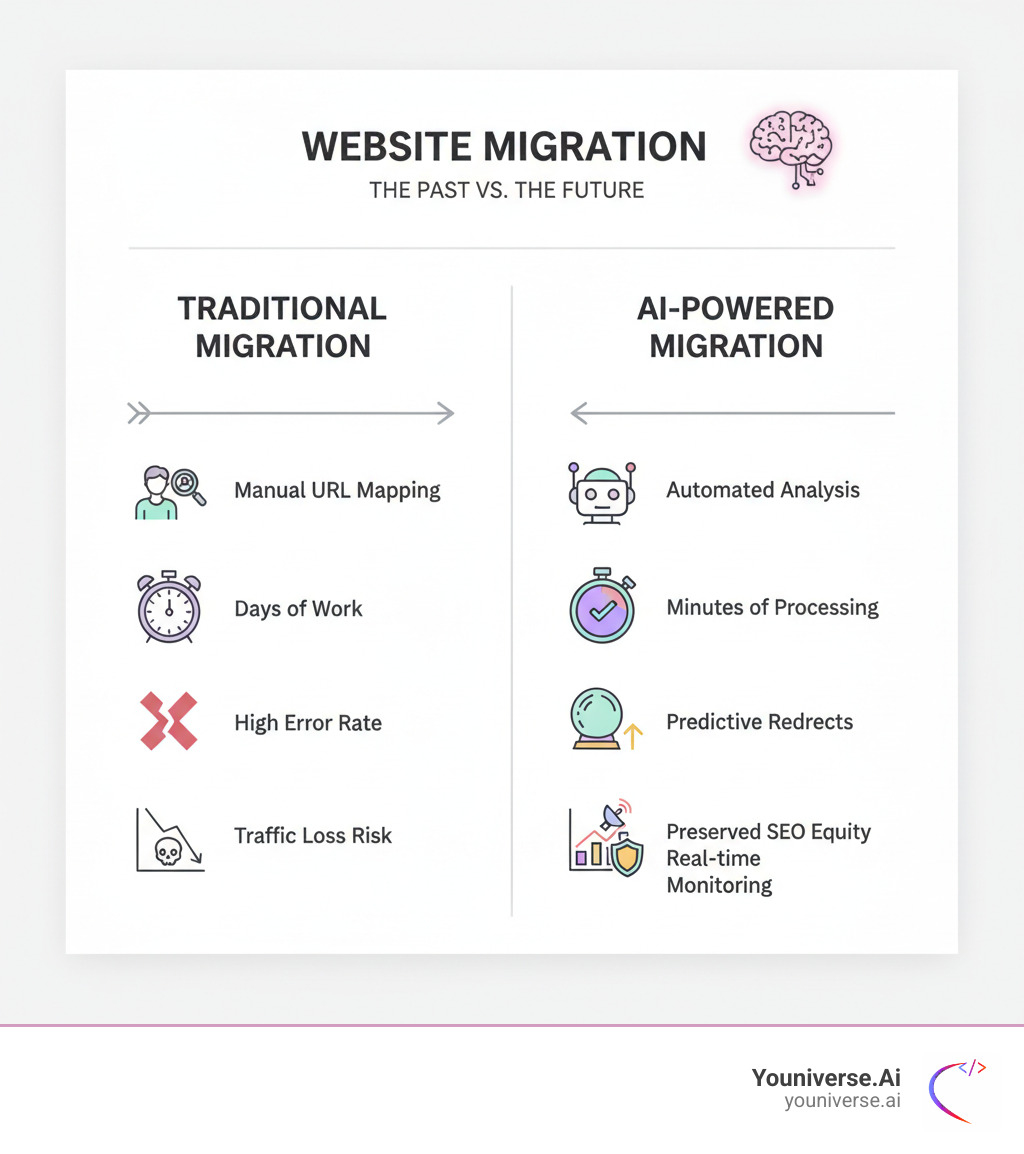
Here's how the two approaches compare:
| Metric | Traditional Migration | AI-Powered Migration |
|---|---|---|
| Time | Days to weeks for URL mapping | Minutes to hours for URL mapping |
| Cost | High agency/labor fees | Significantly reduced |
| Accuracy | Prone to human error, broken links | High, predictive, minimal errors |
| SEO Risk | High risk of traffic loss | Low risk, high preservation |
| Scalability | Limited by human capacity | Highly scalable for any site size |
Want to see what else AI can do for your website? Check out what an AI website builder can actually do for you.
Your Step-by-Step Plan for a Flawless AI Website Migration
Think of website migration like moving to a new house. You wouldn't just throw everything in a truck and hope for the best, right? You'd plan, pack carefully, and make sure everything arrives intact. AI website migration works the same way—except AI does most of the heavy lifting for you.
Let me walk you through exactly how we approach migrations at Youniverse.Ai, broken down into three clear phases.
Pre-Migration: Planning and Preparation with AI
The difference between a smooth migration and a disaster often comes down to what happens before you move a single page. With AI, your preparation phase becomes sharper, faster, and way more thorough.
First, AI-powered site audits scan your entire site in minutes, analyzing structure, metadata, and content to flag SEO issues like duplicate content or broken links. This gives you a complete health report that would take a human team days to create.
Next, content inventory analysis uses AI to catalog every URL and analyze its performance. The AI identifies valuable content by looking at keyword usage and engagement patterns. Advanced AI can even understand your content schema and automatically reshape it to fit your new site's structure, saving immense manual effort.
Now we need to set clear goals together. What do you want from your new website? Better performance? Easier content management? Optimization for AI search engines like ChatGPT and Gemini? Having specific, measurable objectives keeps everyone aligned and gives us a target to aim for.
Even with all this automation, you still need the right team assembled. AI handles the grunt work, but human expertise guides the strategy. We bring together AI developers, data scientists, UX designers, content creators, and IT security specialists—each playing their part in making sure nothing gets overlooked.
Finally, choosing the right AI migration tools matters enormously. We look for solutions that offer flexibility, scalability, and seamless AI integration. Many of our projects leverage modern approaches like the Jamstack architecture, which pairs beautifully with AI tools and delivers lightning-fast performance.
During Migration: AI-Powered Execution
This is where AI really earns its keep. All that planning now turns into action, and AI transforms what used to be a nail-biting process into something surprisingly smooth.
Automated content transfer is first. AI-powered extraction methods move all your content, images, and data with remarkable precision. Migrating a blog with thousands of WordPress posts? AI can import everything quickly and accurately. Some AI systems can even generate multiple redesigned versions of your site based on existing content—so you're not just moving your site, you're potentially upgrading it at the same time.
Then comes the part that usually gives people nightmares: AI-assisted URL mapping. Manually mapping redirects for thousands of URLs is mind-numbing work that takes days and invites mistakes. AI changes everything here. Our systems can predict the most effective redirection mappings based on historical data and structural similarities. That initial map of 10,000 URLs? Minutes instead of days. Then a human reviews it in a few hours, and you're done. We use advanced models like all-MiniLM-L6-v2 and FAISS for sophisticated similarity matching between old and new URLs. If you want to dive deeper into this, check out how to speed up site migrations with AI-powered redirect mapping.
AI doesn't stop at simple one-to-one redirects, though. Predictive redirection means the AI can intelligently suggest redirects even for content you've decided to remove. Instead of letting those old URLs die and create 404 errors, AI guides that traffic to related pages, preserving your valuable link equity and keeping users happy.
Throughout the actual migration, real-time monitoring keeps watch over everything. AI-powered tools track site performance, crawlability, and indexing health as the migration happens. If something starts to go sideways, we catch it immediately and fix it before it becomes a problem.
Once everything's moved, your site needs solid infrastructure to perform at its best. That's why we offer high-frequency WordPress hosting performance for optimal speed and reliability.
Post-Migration: AI-Driven Monitoring and Optimization
Here's something most people don't realize: the migration isn't finished when your site goes live. The work isn't over at launch. AI-driven monitoring and optimization become your most valuable partner. Our tools provide continuous SEO monitoring, running ongoing audits, tracking rankings, and ensuring your SEO equity thrives. Simultaneously, AI-driven performance analysis microscopically examines page speed and Core Web Vitals, spotting bottlenecks before they slow you down. AI also provides deep insights into user behavior, showing you how visitors interact with the new site. Finally, automated issue detection acts as a 24/7 guard, instantly alerting you to broken links, indexing problems, or traffic drops so you can respond immediately.
If you do run into unexpected hiccups, we've got you covered. Check out our guide on troubleshooting your AI website builder issues to keep everything running smoothly.
Navigating SEO and the New World of AI Search

Search is no longer what it used to be. If you've noticed AI-generated summaries appearing at the top of your search results, you're witnessing a fundamental shift in how people find information online. This changes everything about how we approach AI website migration.
When you migrate your website, you're not just moving content from point A to point B. You're repositioning your entire digital presence in a world where AI systems are increasingly deciding which content gets seen. That's why preserving your SEO equity—your rankings, backlinks, and topical authority—is only half the battle now.
Think about how search works today. Google's AI Overviews, Bing's Copilot, and platforms like ChatGPT don't just index your pages and rank them in a list. They read your content, understand it, synthesize information from multiple sources, and then cite the most relevant pieces in their AI-generated answers. If your content isn't structured in a way these AI systems can understand and trust, you're essentially invisible in this new search landscape.
This is where optimizing for AI Overviews becomes critical during migration. It's not enough to simply redirect your old URLs to new ones. Your new pages need to maintain clarity, logical structure, and fast loading speeds. More importantly, they need to preserve what we call "AI equity"—the structured signals, schema markup, and semantic associations that help AI systems interpret your content correctly.
Structured data has taken on a whole new level of importance. While schema markup always helped with rich results in traditional search, it now serves as a translation layer between your content and AI models. When you add FAQPage schema to your common questions or Article schema to your blog posts, you're essentially giving AI systems a roadmap to understand and cite your content. During migration, we make sure your structured data strategy is not just preserved but optimized for AI citation patterns.
Maintaining topical authority matters more than ever because AI search engines value comprehensive, expert content that demonstrates deep knowledge in a specific area. When we migrate your site, we prioritize keeping and improving the content that establishes your expertise. We use schema markup and semantic consistency to signal to AI models that your site is an authoritative source worth citing.
Here's the exciting part: if you get this right during migration, you're not just preserving your existing visibility—you're positioning yourself to thrive in a search ecosystem that most of your competitors haven't even adapted to yet.
This is exactly why we built our approach around Answer Search Optimization. It's not just about keywords anymore. It's about making your content findable, understandable, and citable by the AI systems that are increasingly mediating how people find information online.
Common Challenges and Best Practices
Let's be honest: AI website migration is transformative, but it's not a "set it and forget it" solution. Think of AI as an incredibly skilled assistant rather than a replacement for human judgment. When we understand both the limitations and the potential, we can steer this process with confidence.
Potential Problems in an AI Website Migration
The biggest trap? Over-reliance on automation. I've seen teams get so excited about AI's capabilities that they skip the crucial human review step. While AI can process thousands of URLs in minutes, it doesn't have the intuition to catch context-specific issues. For example, it might suggest redirecting your most popular blog post to a completely unrelated page simply because they share similar keywords.
AI model limitations show up in surprising ways. Sometimes the system will produce what I call "silly errors"—suggestions that make perfect sense to an algorithm but would make any human scratch their head. This output variance is exactly why we never skip the human validation step, especially when reviewing redirect maps with lower similarity scores.
Then there's data privacy. Migrating sensitive data requires ironclad security, including enterprise-grade encryption and compliance with regulations like GDPR and CCPA, especially when handling user data in regulated industries.
Finally, there's a genuine learning curve with sophisticated AI tools. Not everyone on your team will be comfortable jumping into Google Colab to run Python scripts or interpreting complex analytics dashboards. This doesn't mean the tools aren't worth it—it just means you need to budget time for training and support.
Best Practices for a Smooth Transition
![[object Object]](https://images.bannerbear.com/direct/4mGpW3zwpg0ZK0AxQw/requests/000/117/025/376/jMDOvP3KezRe7ZxyYlqoyk8AW/a50c71c819b2e567fc6c28d6cd6bf95f786ad8a1.jpg "[object Object]")
Here's where the magic happens—when you combine AI's power with smart human oversight.
The human-in-the-loop approach is non-negotiable. I design every migration system to surface AI-generated suggestions for human review before they go live. This means someone with actual knowledge of your business is checking whether that redirect makes sense, whether that content mapping preserves meaning, and whether the overall strategy aligns with your goals. AI accelerates the process dramatically, but humans make the final call.
Comprehensive testing saves you from the nightmare scenario of finding problems after launch. We test everything on a staging environment first—functionality, performance, compatibility, security, user experience, and especially those AI-powered features. Does the site load quickly? Do all the forms work? Are your AI-driven recommendations actually helpful? These questions get answered before your users ever see the new site.
For larger, more complex sites, a phased rollout strategy reduces risk significantly. Instead of migrating everything at once, you might move one section of your site at a time. This gives you breathing room to monitor performance, gather feedback, and make adjustments before the next phase. It's like testing the water with your toe before diving in.
Clear stakeholder communication keeps everyone aligned. Your development team needs to know what the marketing team expects. Your clients need to understand the timeline. Your content creators need to know how their work will be affected. Regular updates prevent surprises and build confidence in the process.
Before you flip that switch and go live, run through these essential pre-launch checks:
- Back up everything: content, code, databases, and AI models.
- Test all redirects on a staging server to find loops or errors.
- Verify the new site's technical SEO (speed, mobile-friendliness) meets or exceeds the old site.
- Review the internal linking structure for broken links.
- Double-check that structured data is correctly implemented for search engines and AI.
- Confirm the site meets Web Content Accessibility Guidelines (WCAG).
- Ensure analytics and tag managers are installed and tracking correctly.
- Verify your staging site is not being indexed by search engines.
These practices might sound like a lot, but they're what separate a smooth, successful AI website migration from a stressful scramble to fix problems after launch. The investment in doing it right pays dividends in preserved traffic, maintained rankings, and peace of mind.
Frequently Asked Questions about AI Website Migration
People always have questions when they first hear about AI website migration. It sounds futuristic, maybe even too good to be true. So let me address the most common concerns I hear from business owners and developers who are considering making the switch.
What types of AI tools are used in website migration?
The AI toolbox for website migration is actually quite diverse, and each tool plays a specific role in making your transition smoother.
At the foundation, we use NLP models (Natural Language Processing) like all-MiniLM-L6-v2 and FAISS. These aren't just fancy acronyms—they're the technology that allows AI to understand the meaning and context of your content. They excel at similarity matching, which means they can intelligently figure out which old page should redirect to which new page, even when your URL structure changes completely.
Then there are AI-integrated site crawlers that go far beyond traditional crawling. These platforms analyze your entire site structure, metadata, and content consistency all at once. They spot duplicate content, broken links, and potential SEO issues faster than any human team could manually check.
Predictive analytics platforms are where things get really interesting. These systems don't just react to problems—they forecast them. They can predict traffic dips before they happen, flag URLs that might cause issues, and assess how changes to your internal linking will impact your rankings. It's like having a crystal ball for your website's performance.
For content needs, AI-powered content generation tools can optimize existing content for your new platform or identify gaps where new content might be needed. For code-driven sites, AI coding assistants are invaluable. They suggest code improvements, help with new platform features, and fix bugs on the fly during migration.
Can AI migrate any type of website?
This is an honest question that deserves an honest answer: AI dramatically expands what's possible, but there are still some considerations based on how your current site is built.
If you're running an open-source CMS like WordPress, you're in the sweet spot. AI tools can automate content transfer, handle URL mapping, and even suggest redesign improvements with remarkable efficiency. Custom-built sites that follow an "Everything as Code" approach also work beautifully with AI—coding assistants can integrate directly with your codebase and help with adjustments.
It gets trickier with proprietary or closed-code website builders. Their restrictive nature can make direct migration challenging or even impossible. In these cases, the best path forward is often to rebuild from scratch using a modern AI website builder. This approach allows you to use your old site's content as a blueprint while creating a more flexible and scalable platform ready for future AI integrations.
Sometimes rebuilding beats migrating anyway. If your current platform feels restrictive or outdated, a fresh start with AI-powered tools might give you better long-term results in terms of flexibility, performance, and future AI integration.
How long does an AI-powered migration take?
The timeline depends on your site's complexity, content volume, and target platform. However, AI consistently shortens it compared to traditional methods.
The biggest time-saver is URL mapping, where 10,000 URLs can be processed in minutes instead of days. Automated WordPress migrations can be the fastest, sometimes finishing in under two hours. Other open-source platforms might take longer due to different configurations.
The beauty of AI is its scalability; it handles 100 URLs as efficiently as 1,000,000. While human planning and review are still vital, the AI-driven execution is dramatically faster, minimizing business disruption.
Conclusion: Accept the AI-Powered Future of Your Digital Presence
The days of dreading website migrations are over. You know that sinking feeling when you think about moving your entire site—the broken links, the lost traffic, the weeks of manual work? AI website migration has changed all that.
Throughout this guide, we've explored how AI transforms every aspect of migration. It maps thousands of URLs in minutes instead of days. It predicts problems before they tank your rankings. It preserves your hard-earned SEO equity while dramatically cutting costs. Whether you're running a small business site or managing a massive enterprise platform, AI scales to meet your needs without breaking a sweat.
But here's what really matters: the future of search itself is changing. Traditional Google rankings are just one piece of the puzzle now. AI-powered search engines like ChatGPT and Gemini are reshaping how people find information online. Your website needs to speak their language—structured, clear, and intelligently organized—or risk becoming invisible in this new landscape.
This isn't just about keeping up with technology. It's about positioning your business for long-term success in a world where AI systems decide what content gets seen and cited.
At Youniverse.Ai, we built our platform specifically for this AI-first world. Our AI Search Visibility Engine (AEO) doesn't just help you migrate your website—it optimizes your entire digital presence for the way people actually search today. We're talking about visibility in AI Overviews, ChatGPT responses, and Gemini results, not just traditional search rankings.
The web development landscape will continue evolving, and AI will be at the center of that evolution. The businesses that thrive will be the ones that accept these tools now, not the ones waiting on the sidelines wondering if AI is just a passing trend.
Your website migration doesn't have to be a nail-biting experience filled with worst-case scenarios. With AI handling the complex technical work, you can focus on what really matters—growing your business and serving your customers.
Ready to make the leap? Start your seamless website migration today and find how much easier (and smarter) your digital presence can be. The future isn't coming—it's already here, and it's powered by AI.