


Future of AI search: 2025's Exciting Shift
Why the Future of AI Search Matters Right Now
The future of AI search isn't a distant concept—it's reshaping how we find information today. Search engines have transformed from link directories into intelligent assistants that understand questions, synthesize answers, and hold conversations. Instead of scanning ten blue links, users now get direct, AI-generated summaries from multiple sources.
Here's what you need to know:
- Half of consumers already use AI-powered search (ChatGPT, Gemini, Perplexity).
- $750 billion in US revenue will flow through AI search by 2028.
- 44% of AI search users say it's their primary source of insight, beating traditional search.
- 20-50% traffic decline is possible for unprepared brands.
- Google's AI Overviews now reach over 1.5 billion users monthly.
This isn't just a new feature—it's a new front door to the internet. AI search uses large language models (LLMs) like GPT-4 to understand intent, retrieve relevant information, and deliver conversational answers. Users are asking longer, more complex questions and expecting instant, synthesized responses.
Your brand's visibility in ChatGPT, Gemini, and Google's AI Overviews will soon matter as much as your Google ranking. Most brands aren't ready—only 16% systematically track AI search performance.
I'm Matthias Hamm, founder of Youniverse.Ai. I've spent a decade in web development, SEO, and AI integration, helping businesses rank not just on Google, but within AI engines. My work focuses on AI Engine Optimization (AEO) to help businesses adapt and thrive. Let's explore what this change means for you.
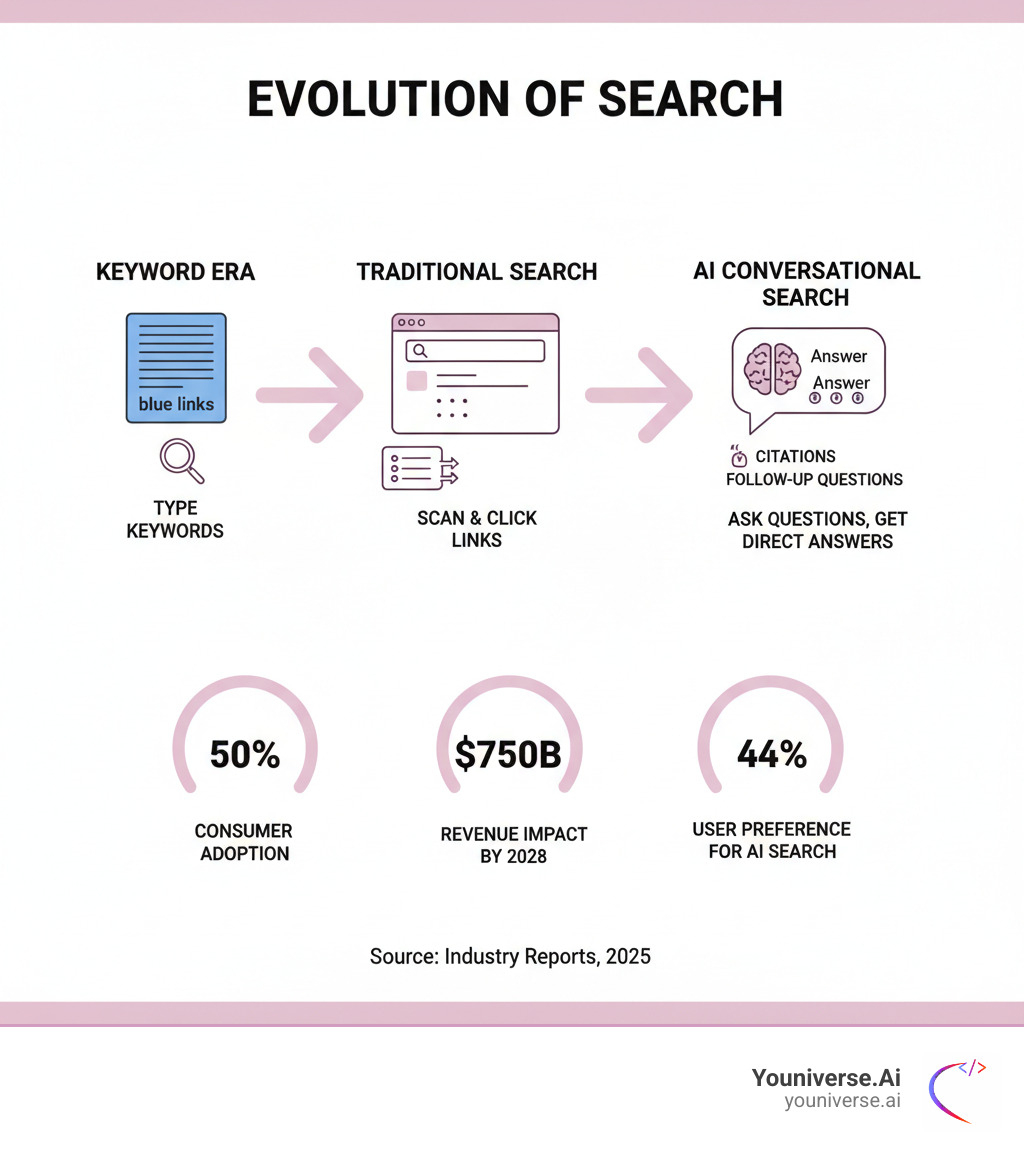
From Keywords to Conversations: The AI Search Revolution is Here
Remember getting an answer from Google instead of just a list of links? That's the future of AI search, and it's already here. For decades, we thought in keywords, scanning ten blue links and doing the research ourselves. Now, we can ask a real question and get a synthesized, conversational answer that makes sense.
This isn't just an upgrade—it's a complete reimagining of how we find information online.
The old search model was "crawl-index-rank." Bots crawled the web, indexed pages, and ranked them for your keywords. It was brilliant, but it left you to piece the answer together. AI search flips this model. It uses Large Language Models (LLMs) and Retrieval-Augmented Generation (RAG) to understand what you're asking. It then pulls information from multiple sources, synthesizes it, and gives you a direct answer with citations.
Traditional search finds pages. AI search understands intent and delivers answers.
How Search Works: The Old Way vs. The New AI Way
Let's break down the mechanics to see why this shift is so significant.
Traditional Search Explained: The Keyword Matching Game
The search engine you grew up with works in three steps: crawling (bots find content), indexing (content is analyzed and stored), and ranking (algorithms find the most relevant pages for your keywords). This system, which Google explains in detail here, is about matching your keywords to documents. It points you toward information, but you do the rest.
AI Search Explained: The Semantic Understanding Revolution
AI search keeps the crawling and indexing but transforms what happens next. It grasps meaning.
Large Language Models (LLMs) like Gemini and GPT-4 are trained on enormous amounts of text, allowing them to understand natural language, context, and intent. When you ask a question, the LLM processes it as a concept, not just keywords.
Then, Retrieval-Augmented Generation (RAG) retrieves current, relevant information from live sources. The LLM uses this fresh data to generate an accurate, grounded answer with citations. This is powered by vector search, which converts your query and documents into numerical vectors to find conceptual matches, not just keyword matches. That's why AI search feels so much smarter—it's looking for meaning.
The Good, The Bad, and The AI: Advantages & Disadvantages
AI search has incredible benefits and real challenges.
What Makes AI Search Amazing
- Speed: Get a synthesized answer in seconds instead of opening multiple tabs.
- Complex Questions: AI easily handles multi-part questions, like comparing products or services.
- Conversational Experience: You can ask follow-up questions and refine your search naturally.
- Multimodal Capabilities: Search using your voice, images, and even video.
Where AI Search Falls Short (For Now)
- Hallucinations: AI can generate confident-sounding but incorrect answers. The challenge of AI hallucinations is real, so you can't blindly trust every answer.
- Bias: AI models can reflect and amplify biases present in their training data.
- Source Opacity: While citations are often provided, the synthesis process can obscure original context.
- Fewer Clicks: Direct answers mean users have less reason to click through to websites, potentially causing a 20-50% decline in traffic for businesses that don't adapt.
Despite these challenges, the momentum is undeniable. Users are embracing AI search, making it crucial to understand both its promise and its pitfalls.
Meet the New Search Masters: How Tech Giants Are Wielding AI
The giants of tech are actively building the future of AI search. Google, Microsoft, and innovative newcomers are in an arms race to deliver the smartest search experience. We're moving beyond keywords into a world of conversational dialogues, where we ask questions with our voices, cameras, and videos, and get synthesized insights in return.
Google's Grand Plan: AI Overviews and the Gemini Era
Google is integrating generative AI across its entire platform. The centerpiece is Search Generative Experience (SGE), which uses the Gemini AI model to create "AI Overviews" at the top of search results. These synthesized answers now reach over 1.5 billion users monthly and are driving growth in how often and how complexly people search.
Google is also weaving in other powerful features:
- Conversational follow-ups let you ask subsequent questions without losing context.
- AI-organized results group information into helpful categories for broad topics.
- Multimodal search allows you to search with your camera via Google Lens, which is used by 1.5 billion people monthly. You can even search with video.
- Project Astra is pushing this further with live, conversational interactions using your camera.
Google is also experimenting with planning tools and agentic capabilities to help you brainstorm itineraries or even complete tasks like buying tickets. By the end of the year, Google aims to reach over a billion people with AI Overviews, cementing generative AI as the core of search's future. This is genuinely reshaping Google's page as we know it.
The Rise of "Answer Engines" and AI Copilots
While Google is a dominant force, other players are pioneering the "answer engine" approach.
Microsoft made waves by launching the new Bing with a chat mode powered by OpenAI's GPT-4. This AI copilot offers conversational answers alongside traditional web links. The move was a success, with Bing with GPT-4 surpassing 100 million daily active users. Microsoft also integrated GPT-4 into its core search with Deep Search, which expands complex queries for more thorough results.
Dedicated answer engines are also gaining traction. Perplexity.ai, launched in 2022, provides answers with carefully cited sources and functions as a powerful research co-pilot. Its rapid growth is seen by some as revealing a crack in Google's dominance.
These innovations are all powered by Large Language Models like Gemini and GPT-4, which enable systems to understand natural language, synthesize information, and generate coherent, context-aware responses.
The New Rules of the Game: Winning in the Future of AI Search
The future of AI search is rewriting the playbook for how businesses get found. If you're still relying only on traditional SEO, you're falling behind. The good news? Adapting now gives you a massive advantage.

When a customer asks ChatGPT or Google's AI Overview for a recommendation, they get a direct answer. They aren't clicking through ten websites. With 44% of AI search users calling it their primary source of information and 40-55% of consumers using it for purchasing decisions, your visibility in these answers is critical. If you're not there, you're invisible.
Experts predict a 20-50% traffic decline from traditional search for businesses that don't adapt. But this shift also creates incredible opportunities for those who learn to work with AI search engines.
Beyond SEO: Are You Ready for AEO (AI Engine Optimization)?
Welcome to the era of AI Engine Optimization (AEO). The goal is no longer just to rank in a list, but to become the source that AI assistants cite and recommend. At Youniverse.Ai, we call this Generative Search Optimization. It's about optimizing for how AI models like Gemini and GPT-4 understand and present information.
- Create citable content: Your new north star is to become an authoritative source that AI trusts. This means factual, well-researched, and genuinely useful content.
- Answer questions directly: Don't make AI or readers hunt for information. State answers clearly and upfront.
- Use natural language: Write like a human, not a robot. Conversational content performs better because it's how AI models are trained and how users are searching.
- Leverage structured data: Use Schema.org markup to give AI a roadmap to your content. Labeling prices, reviews, and business hours makes it easy for AI to extract and present accurate information.
For businesses in York PA, Red Lion PA, and Harrisburg PA, this is a chance to dominate local AI search with hyper-local expertise.
Why Authority is the New Currency in the Future of AI Search
In the age of AI, authority is your golden ticket. AI models prioritize sources that demonstrate real expertise, experience, authoritativeness, and trustworthiness (E-E-A-T). Google's E-E-A-T guidelines are now more important than ever.
AI needs to provide helpful, accurate answers. It won't trust a sketchy or superficial source. To be cited by ChatGPT or Gemini, your content must show genuine knowledge and credibility.
Build topical authority by going deep, not wide. Create comprehensive coverage of your core expertise. If you're an HVAC company in Lancaster PA, cover everything from seasonal maintenance to smart thermostats. Become the undisputed expert, and AI will notice.
This directly impacts purchasing decisions. When someone in Towson MD asks an AI for a local recommendation, you want your business to be the one it suggests. This only happens when you've established yourself as a trusted authority. As AI is refined to combat hallucinations, it will increasingly rely on verified, trustworthy sources, a shift that is fundamentally changing marketing strategy. Your reputation and authority directly determine your visibility.
What's Next on the Horizon? Challenges and Opportunities in AI Search
The future of AI search is a hybrid world where traditional results and AI-generated answers coexist, each serving different needs. This evolution is exciting, but it comes with growing pains. As AI search becomes more powerful and personal, we face serious questions about fairness, accuracy, and privacy.
Navigating the Pitfalls: Bias, Privacy, and "Fake" Facts
AI search is powerful, but not perfect. Here are the key challenges:
- Content Moderation: How do we ensure AI-generated summaries from billions of web pages are appropriate and accurate? As platforms license their content to train AI, who is responsible for the reliability of that information?
- Algorithmic Bias: AI learns from human-created data. If that data contains societal biases, the AI will absorb and potentially amplify them, affecting everything from search results to source citations.
- Privacy: Personalization is convenient, but it requires sharing personal data. We need to be aware of how our information is used. Platforms like Google are offering more control, and you can explore Your privacy controls to manage your settings.
- "Fake Facts": AI can still hallucinate, confidently presenting incorrect information. Always verify crucial information from AI search, especially for important decisions. Look for citations and cross-check with trusted sources.
For users in York PA, Red Lion PA, and Harrisburg PA relying on AI for local decisions, it's important to be both excited and cautious.
A Glimpse into 2030: The Exciting Future of AI Search
By 2030, AI search will look less like a search engine and more like an intelligent assistant that does things for you.
- Agentic AI: This is the game-changer. Instead of just finding restaurants in Lancaster PA, an AI agent could check availability and make a reservation for you. Google is already experimenting with this for tasks like buying tickets.
- Proactive Assistance: AI will anticipate your needs, suggesting packing lists for a trip to Shrewsbury PA based on the weather or recommending local events before you even ask.
- A "Multi-Search Universe": We'll use specialized AI tools for different needs—Google for quick facts, a dedicated engine for deep research, and perhaps a hyper-local AI for business recommendations in Towson MD.
- The Hybrid Model: The blend of AI answers and traditional links is the destination, not just a transition. This approach, representing a massive influx of new innovations, gives users the flexibility to choose between a quick summary and a deep dive.
- Hyper-Personalization with Privacy: AI will understand your preferences with greater sophistication, but you'll have clear, simple controls to manage your data connections.
- Natural Multimodal Search: Searching with your voice while driving or pointing your camera at an object to ask a question will feel completely normal.
The future of AI search is about moving from information retrieval to intelligent action. For businesses working with Youniverse.Ai, the opportunity is to become the trusted source these intelligent systems turn to.
Frequently Asked Questions About AI Search
The Future of AI search is unfolding fast, and you likely have questions. We hear these from clients across York PA, Lancaster PA, and Harrisburg PA. Let's tackle the big ones.
Will AI search make my website's SEO worthless?
No, your SEO isn't worthless—it's evolving. Traditional SEO focused on ranking in the "ten blue links." That still has a place, but the game is changing.
We're now in the era of AI Engine Optimization (AEO). The goal is to optimize for how Large Language Models like Gemini and GPT-4 understand and cite your content. Authority (E-E-A-T) is more critical than ever. AI models want to cite credible, comprehensive content from real experts.
If your website demonstrates genuine expertise and answers questions directly, AI will use your content to generate answers. Your goal is to become the source AI wants to cite. The fundamentals of creating valuable content still win.
How can my business get ready for this change?
Getting ready for the Future of AI search requires a strategic shift. Here's what we recommend to businesses in Red Lion PA, Shrewsbury PA, and Towson MD:
- Create High-Quality, Expert Content: This is non-negotiable. AI prioritizes credible sources. Go deep on your subject matter to prove your authority.
- Answer Questions Directly: Think about what your customers ask, and answer those questions explicitly in your content. Put the answer right up front.
- Use Structured Data (Schema): Add Schema markup to your pages to give AI a clear roadmap to your information—business hours, services, reviews, etc. This makes it easy for AI to find and cite accurate details.
- Focus on Local Relevance: If you serve a specific area like York PA, create content that answers hyper-local questions to establish yourself as the regional expert.
- Ensure a Technically Sound Website: Fast load times, mobile-friendliness, and a good user experience signal to AI that your site is trustworthy.
At Youniverse.Ai, our AI Search Visibility Engine is built to help businesses get featured in AI-powered search results.
Can I trust the answers from AI search?
This is a crucial question. The short answer: use AI search as a starting point, but always verify important information.
AI is powerful, but it can "hallucinate"—generate information that sounds convincing but is incorrect. For everyday queries, it's generally reliable. But for high-stakes decisions involving health, finances, or legal matters, you must verify what AI tells you.
Our rule of thumb: if the answer matters, check the sources. Many AI search engines provide citations. Click through and confirm the information, especially if you're unfamiliar with the topic.
Think of AI search as a knowledgeable friend. It's a great guide, but for the important stuff, do your own research. The Future of AI search is about augmenting our abilities, not replacing critical thinking.
Conclusion
The Future of AI search isn't a distant possibility—it's here now. We've moved from "ten blue links" to an era where search engines understand our intent and converse with us like knowledgeable assistants. This is a complete paradigm shift in how we use the internet.
Powered by models like Gemini and GPT-4, AI search grasps our intent, synthesizes information, and delivers conversational answers. This evolution brings incredible efficiency and personalization, but also challenges like AI hallucinations and bias that require our critical thinking.
For businesses, the message is clear: authority is your golden ticket. The brands that thrive will be those creating high-quality, citable content that demonstrates genuine expertise. Traditional SEO is no longer enough; we must accept AI Engine Optimization (AEO), structuring our content so AI assistants can understand, cite, and recommend it.
In York PA, Red Lion PA, Shrewsbury PA, Harrisburg PA, Lancaster PA, and Towson MD, local businesses have a unique opportunity. Your hyper-local expertise is valuable currency. By answering the specific questions your community is asking, you can become the authoritative voice AI turns to.
At Youniverse.Ai, we're helping businesses steer this change. Our AI Search Visibility Engine is built for this new era, optimizing your presence for AI search results in ChatGPT, Gemini, and beyond. Don't let your brand become invisible while your competitors claim the spotlight.